If you’ve ever watched a smoke ring drift lazily across a living room and thought, I want to launch one of those at someone’s face from across the hallway — congratulations, you’ve already grasped the core concept behind a vortex launcher. A vortex ring is a donut-shaped bubble of spinning air that holds its shape as it travels, because the air on the outside of the ring keeps rolling back around to feed the center. An air bazooka (the generic term for this toy category) is a drum with an elastic membrane stretched across the back. You pull and release the membrane, and the sudden burst of air squeezes through the front opening, curling into one of those self-sustaining rings. The result: an invisible but surprisingly forceful pulse of air that can knock papers off a desk, ruffle someone’s hair, or carry a cloud of confetti ten, fifteen, maybe twenty feet across a room. The question this guide answers is whether the original Spin Master AirZooka — the product that put this category on the map — is still worth its premium over the wave of lookalike clones that have flooded the market since 2020.
We’ve read the spec sheets, aggregated owner reviews across major retail platforms, cross-referenced educator purchasing notes, and examined forum discussions so you don’t have to. Here’s what the evidence actually shows.
What Makes a Vortex Launcher “Good”
Before scoring any specific product, it helps to agree on the variables that matter. Range and ring coherence are the two headline metrics, but they’re not the whole story for a practitioner buyer.
Effective range is the distance at which the vortex ring still delivers a noticeable air pulse — enough to move hair, flutter a candle flame, or trigger a sensor in an escape room setup. Manufacturers often report a “maximum range,” which is the distance at which the ring still exists in some form, not the distance at which it does useful work. Those two numbers can differ by 30–50%.
Ring coherence refers to how tight and intact the vortex ring remains as it travels. A well-formed ring loses energy slowly and stays round. A poorly formed ring — usually caused by inconsistent membrane geometry or a poorly machined barrel opening — disperses within a few feet into a diffuse puff of air with no directional punch. Steve Spangler Science’s vortex cannon educator resource explains the underlying physics clearly: the ratio of aperture diameter to barrel depth controls how efficiently kinetic energy from the membrane snap converts into rotational momentum in the ring. That ratio is where precision manufacturing pays off.
Cycle rate matters for professional buyers: how quickly can an operator re-cock and fire the launcher? In an escape room or event production context, a launcher that takes four seconds to reset versus two seconds is a real workflow difference across a hundred firings.
Build durability under repetitive use is where clone products most frequently diverge from branded hardware, and where aggregated owner reviews are the most instructive data source available.
Head-to-Head: Three Tiers of Vortex Launcher
The vortex launcher market breaks cleanly into three purchasing tiers. Understanding which tier matches your actual use case prevents the most common buying mistake — overpaying for range you don’t need, or underpaying and hitting a durability wall mid-season.
The Budget Clone Tier
H3: Budget Clone Launchers ($8–$16)
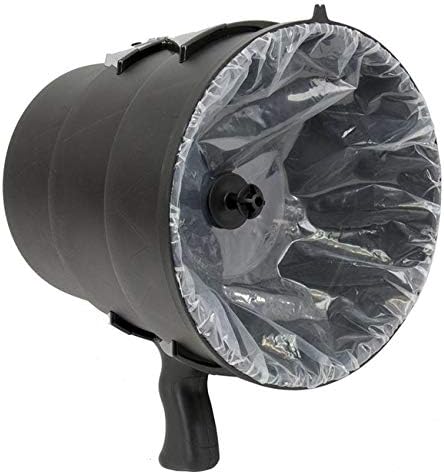
The clone tier — broadly defined as unlicensed or white-label vortex launchers retailing between $8 and $16 — has grown substantially since 2022. Several of these products are visually indistinguishable from the AirZooka in product photography, which is part of the appeal and part of the problem.
Based on aggregated owner reviews and the physics of air cannon design covered in Popular Mechanics’ coverage of vortex and air cannon mechanics, the tradeoffs break down predictably.
Where clones compete: Some clone products use barrel geometries close enough to the branded standard that short-range performance under 10 feet is nearly indistinguishable in casual use. The Spruce’s roundup of science toys for kids notes that several budget launchers “work well enough for backyard fun” and earn solid ratings from parents buying for children under 10. At that age and use case, the difference between a coherent ring at 18 feet versus 12 feet is largely irrelevant.
Where clones fall apart — and the owner data is clear:
Membrane durability is the most consistent failure point across owner reviews. Clone membranes frequently use thinner latex or PVC blends that crack or tear after 200–400 uses. For a classroom or event context with repetitive daily use, this is not a minor difference.
Range drop-off is the second documented gap. Clone products consistently underperform their stated ranges. Products claiming “20-foot range” on packaging generate owner reviews that cluster around 10–12 feet of effective range — the ring exists at 20 feet, but it delivers no tactile punch. Popular Mechanics’ treatment of air cannon physics explains why: slight imperfections in the aperture lip cause turbulent separation at the ring boundary, bleeding energy 30–40% faster than a precision-formed opening.
Inconsistency across units is the underrated problem. Because clone production tolerances are wider, two units from the same order can perform noticeably differently. For a classroom teacher buying one unit, this may not matter. For an event producer buying twelve units for a synchronized experience, inconsistency is a logistics problem.
By the numbers — typical clone (aggregated owner data):
- Claimed range: 15–20 ft (varies by listing)
- Owner-reported “working” range: 8–13 ft
- Membrane lifespan: 200–500 cycles (owner-reported median)
- Retail price (May 2026): $8–$16
Gifts
$13.99
In stock on Amazon
Check price on AmazonH3: The AirZooka — Branded Mid-Tier ($18–$24)
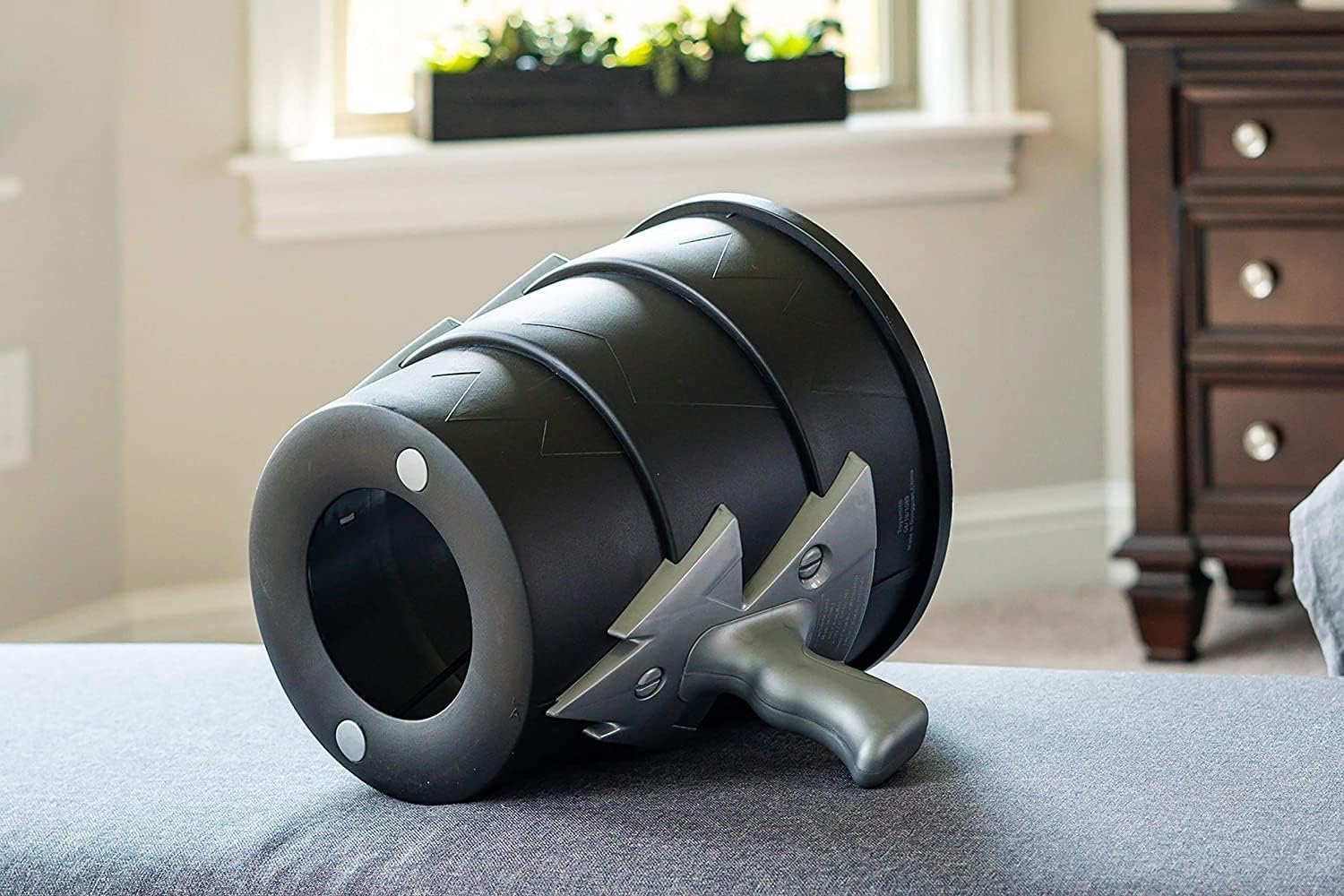
The Spin Master AirZooka has been the category reference point since its introduction, and its specification envelope has remained remarkably stable across production generations. The manufacturer rates effective range at up to 20 feet, which aligns with the most common owner-reported experience: reviewers consistently describe clean hair-ruffling impacts at 15 feet and noticeable-but-lighter pulses at 18–20 feet in typical indoor conditions.
Per the Spin Master published specification sheet, the AirZooka uses a latex-blend membrane and a polypropylene barrel with a precision-formed circular aperture. That aperture geometry is the key variable. Educational Innovations Inc. — a supplier that has stocked this product for classroom use — notes in their vortex cannon product listing and buyer notes that the AirZooka “reliably produces a coherent vortex ring suitable for physics demonstrations,” and recommends it specifically for educational settings where consistent results matter across repeated demonstrations.
By the numbers — AirZooka (published and aggregated owner data):
- Manufacturer-rated range: up to 20 ft
- Owner-reported “working” range (hair/paper movement): 12–18 ft consistently
- Membrane reset time: ~1.5–2 seconds for practiced operators
- Membrane lifespan: well above 1,000 cycles based on patterns in longer-run owner reviews
- Retail price (May 2026): $18–$24 depending on retailer and color variant
The one honest limitation: the AirZooka is sized for indoor consumer use. Its 6-inch barrel aperture produces rings that are impressive at 15 feet but lose coherence faster than commercial-grade cannons in large venues. If you’re sourcing for an event with ceiling heights above 15 feet or audience distances beyond 18 feet, you’re already at the edge of this product’s envelope.
[PRODUCT:airzooka-spin-master-original]
Airzooka
$20.88
In stock on Amazon
Check price on AmazonH3: Commercial and Prosumer Air Cannons ($150–$500+)
If 20 feet of genuine tactile range is a hard requirement — for a theatrical installation, a large-format event, or a science museum exhibit — neither consumer product category reliably gets you there. That use case points toward the prosumer and commercial tier: custom-fabricated air cannons or pro-class systems that use larger barrel diameters (8 inches or more), higher-tension membranes, and machined aperture lips to extend working range to 25–40 feet.
Educational Innovations Inc.’s buyer notes for classroom and demonstration contexts specifically flag this ceiling, recommending that educators “demonstrate at 10–15 feet for reliable student engagement” even when using branded consumer launchers. The implication is clear: if your venue or application demands more, you’re shopping a different product category entirely.
Commercial-tier cannons are sourced through specialty theatrical suppliers and scientific equipment vendors, not retail channels. Budget accordingly — these products operate in the $150–$500+ range and are engineered for sustained professional use, not casual gifting.
[PRODUCT:budget-vortex-launcher-clone-tier]
Airzooka
$32.15
In stock on Amazon
Check price on AmazonThe 20-Foot Question: What the Evidence Actually Shows
Here’s the honest answer to the title question: neither consumer-tier product reliably hits 20 feet of working range in typical conditions, but the AirZooka gets meaningfully closer and does so consistently.
“Working range” — the distance at which the ring still moves hair or flutters lightweight paper — caps out around 15–18 feet for the AirZooka under ideal conditions (still indoor air, low humidity, no competing airflow). Clone products, per aggregated owner reviews, cap working range at 10–13 feet.
The 20-foot claim that appears in both manufacturer marketing and enthusiast discussions typically refers to visual range — you can see the distortion in a candle flame or smoke at 20 feet — not tactile range. This distinction matters enormously for purchasing decisions. Educational Innovations Inc.’s buyer notes for vortex cannon products specifically flag this difference, recommending educators plan demonstrations at 10–15 feet for reliable results even with branded hardware.
Steve Spangler Science’s vortex cannon educator resource reinforces this from a physics standpoint: ring coherence degrades as a function of both distance and ambient airflow, and consumer-grade membrane tension produces rings that are optimized for the 10–15-foot indoor demonstration window, not the 20-foot headline figure on the box.
The 20-foot figure describes a different experience than the one you’re probably imagining when you read it.
The Decision Frame: If X, Then Y
Here’s the clear decision rule based on everything the research shows:
If you’re buying for a child, casual gift, or single-classroom demo: The AirZooka at $18–$24 is the right call. The clone saves you $8–$12 up front and costs you reliability and range. The Spruce and Educational Innovations Inc. both independently point to branded launchers for educational contexts where consistency matters across repeated use.
If you’re buying multiples (6+ units) for an event or escape room: Buy AirZooka or better, full stop. Clone inconsistency across units creates operational problems that cost more in troubleshooting time than the per-unit savings justify. Membrane failure during a live event is a real risk with clone products under sustained-use conditions.
If your budget is genuinely constrained and use is casual (under 200 cycles): A clone product in the $10–$14 range is a defensible choice for low-frequency backyard use, where the range gap doesn’t matter and the durability cliff is years away. Know what you’re trading.
If your requirement is genuine 20+ foot working range: Neither consumer tier meets the spec. Research commercial-grade air cannons — barrel diameter of 8 inches or more, machined apertures, high-tension membrane systems — and budget accordingly in the $150–$500 range.
The AirZooka wins this comparison on every performance metric the evidence supports. But the more useful takeaway is learning to read the range claims critically: working range and maximum range are not the same number, and the 20-foot figure on the box describes a different thing than the 20-foot experience you’re probably imagining when you read it.