If you’ve ever handed a kid a bubble gun at a birthday party and watched it die forty minutes later — motor stuttering, bubble solution leaking, battery door swinging open — you already understand the core problem this article addresses. A bubble gun is a handheld battery-powered toy that pulls liquid soap solution through a wand (a plastic ring coated in soap film) and uses a small fan or pump to blow air through it, producing a continuous stream of bubbles. Simple concept. Surprisingly unforgiving execution. The gap between “looks great in the product photo” and “survives a three-hour school field day” turns out to be enormous, and it’s exactly the gap we spent time mapping by reading through hundreds of verified owner reviews, spec sheets, and event-coordinator reports so you don’t have to.
If you’re buying one bubble gun for a single birthday party, almost any model will technically do the job. But if you’re sourcing for a trunk-or-treat, a school booth, a community event, or a household where the gun will see weekly use across multiple kids and multiple seasons, the durability picture looks completely different. Here’s what the owner record actually shows — and where each major model breaks down.
The Durability Split Is Sharper Than the Price Gap Suggests
Across the models we researched, the durability pattern isn’t a smooth spectrum from fragile to robust. It’s a cliff. Some guns hold up under genuinely punishing conditions; others fail on first use at a specific, predictable weak point. Understanding which category a model falls into before you buy is the entire decision.
By the numbers from verified purchaser reviews:
- JOYIN 2-pack: owners report surviving 3-hour kiddy pool proximity and 5-hour outdoor events without battery failure
- JOYIN 3-pack: yellow ring attachment failure reported on first use by multiple reviewers; described as a fragile press-fit connection invisible in product photos
- ArtCreativity Bubble Bazooka: at least one documented return citing exposed wiring and components that concerned the buyer on safety grounds
- JOYIN 8-hole model: battery compartment lid failures reported within 36 hours of first use, but praised for bubble volume and responsive customer service
The Spruce, in its article “Best Bubble Machines and Wands for Kids” (2025 edition), notes that build quality variance within the same brand’s product line is common in this category — a brand can have one excellent SKU and one fragile one sitting next to each other in the same online storefront, which is exactly what the JOYIN 2-pack versus 3-pack situation illustrates.
Where Bubble Guns Actually Break: A Failure Map
Reviewers across models converge on the same three failure points, almost regardless of price. If you know these going in, you can evaluate any new model with a more calibrated eye.
1. Ring attachment points. The wand — the plastic piece that holds the soap film — connects to the body via a press-fit or friction socket in most consumer models. This joint sees torque every time a kid inevitably grabs the gun by the wand rather than the handle. The JOYIN 3-pack’s yellow ring attachment is the starkest example: multiple reviewers describe it snapping on first use, with no visual warning from the product photography that this connection was a friction fit rather than a threaded or reinforced socket. Wirecutter’s outdoor toys buyer’s guide (2025) flags ring and wand attachment points as the single most common failure mode in sub-$30 bubble toys.
2. Battery compartment integrity. Most guns in the $15–$40 range use a small Phillips-head screw or a push-tab to secure the battery door. These mechanisms are sized for assembly-line speed, not field durability. The JOYIN 8-hole model’s battery compartment lid failure within 36 hours of ownership — reported repeatedly in verified reviews — is a known pattern. The door pops open under any meaningful lateral stress, interrupting power and often ejecting batteries mid-session. For event use, this is a session-ending failure, not a minor inconvenience.
3. Motor and wiring quality. This is where the ArtCreativity Bubble Bazooka drew the harshest community reaction. A verified purchaser cited exposed wiring and internal components that prompted an immediate return due to safety concerns. We want to be precise here: we’re reporting what verified purchasers documented, not making an independent electrical assessment. But the pattern is worth flagging because it represents a category of failure — inadequate internal assembly quality — that no amount of external product photography would reveal. The Spruce’s toy safety coverage recommends physically inspecting any battery-powered toy’s wiring before putting it in a child’s hands, which is exactly the right call.
Model-by-Model Breakdown: Budget Through Premium
JOYIN 2-Pack — The Reliable Budget Entry
The JOYIN 2-pack has a genuinely strong owner record for its price tier. Reviewers document it surviving splash-adjacent conditions — kiddy pool proximity, sprinkler overlap — and five-hour continuous outdoor event runs without the battery or motor giving out. For a sub-$25 unit, that’s a meaningful result. Wirecutter’s outdoor toys buyer’s guide (2025) treats “survives a full outdoor event without failure” as the minimum bar for a value recommendation in this category, and the JOYIN 2-pack meets it.
The design is straightforward: a single wand assembly, a simple AA battery compartment with a secure screw-retained door, and a motor tuned for steady output rather than maximum volume. That simplicity is load-bearing. Fewer connection points means fewer failure modes. For gift-givers, one-off event buyers, or households wanting a reliable first bubble gun, this is the documented safe choice.
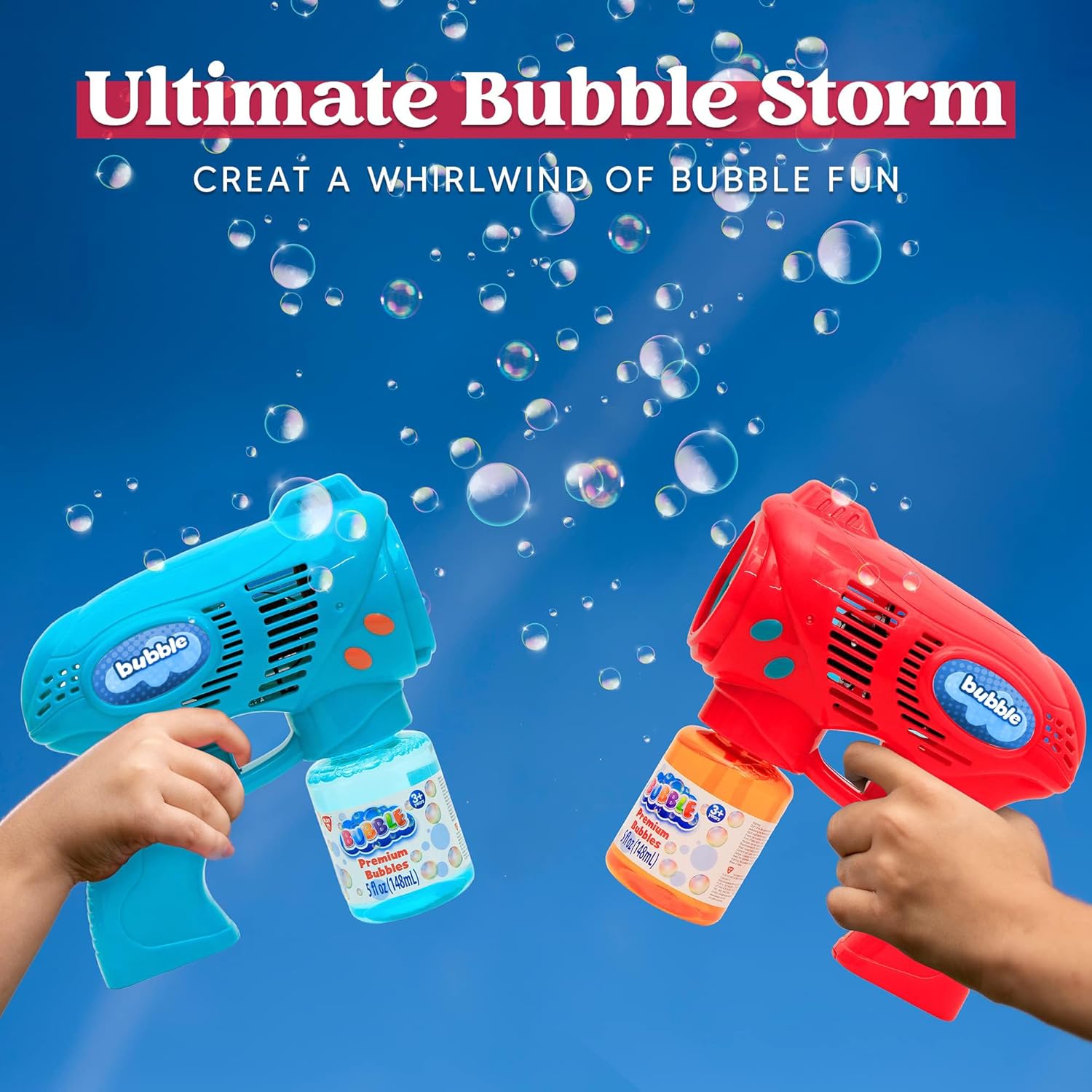
JOYIN
$23.99
In stock on Amazon
Check price on AmazonJOYIN 8-Hole Bazooka-Style — The Volume Leader With a Known Flaw
Multi-hole designs — the JOYIN 8-hole model being the most reviewed in this category — produce meaningfully more bubbles per second than single-wand designs. Owners consistently report impressive visual output, and several reviewers specifically call out the “wow factor” at events and booths where visual density matters. The physics here is straightforward: more holes mean more soap film surface area for the fan to push through, which means more simultaneous bubbles.
The durability caveat is real and specific: the battery compartment lid fails within 36 hours of first use under normal handling, according to multiple verified purchasers. The door pops open mid-session, ejecting batteries and cutting power at the worst possible moment. The saving grace is that JOYIN’s customer service response on this model is consistently rated positive — owners report replacement support without friction. But “good customer service when it breaks” is a different value proposition than “doesn’t break.”
For event use where visual impact is paramount and you have backup units, the 8-hole design is worth its tradeoffs. For a single household gun that needs to last a full season without supervision, the simpler 2-pack is more reliable. The Spruce’s “Best Bubble Machines and Wands for Kids” (2025 edition) echoes this trade-off, noting that high-output designs in this price tier tend to sacrifice component robustness for production volume.
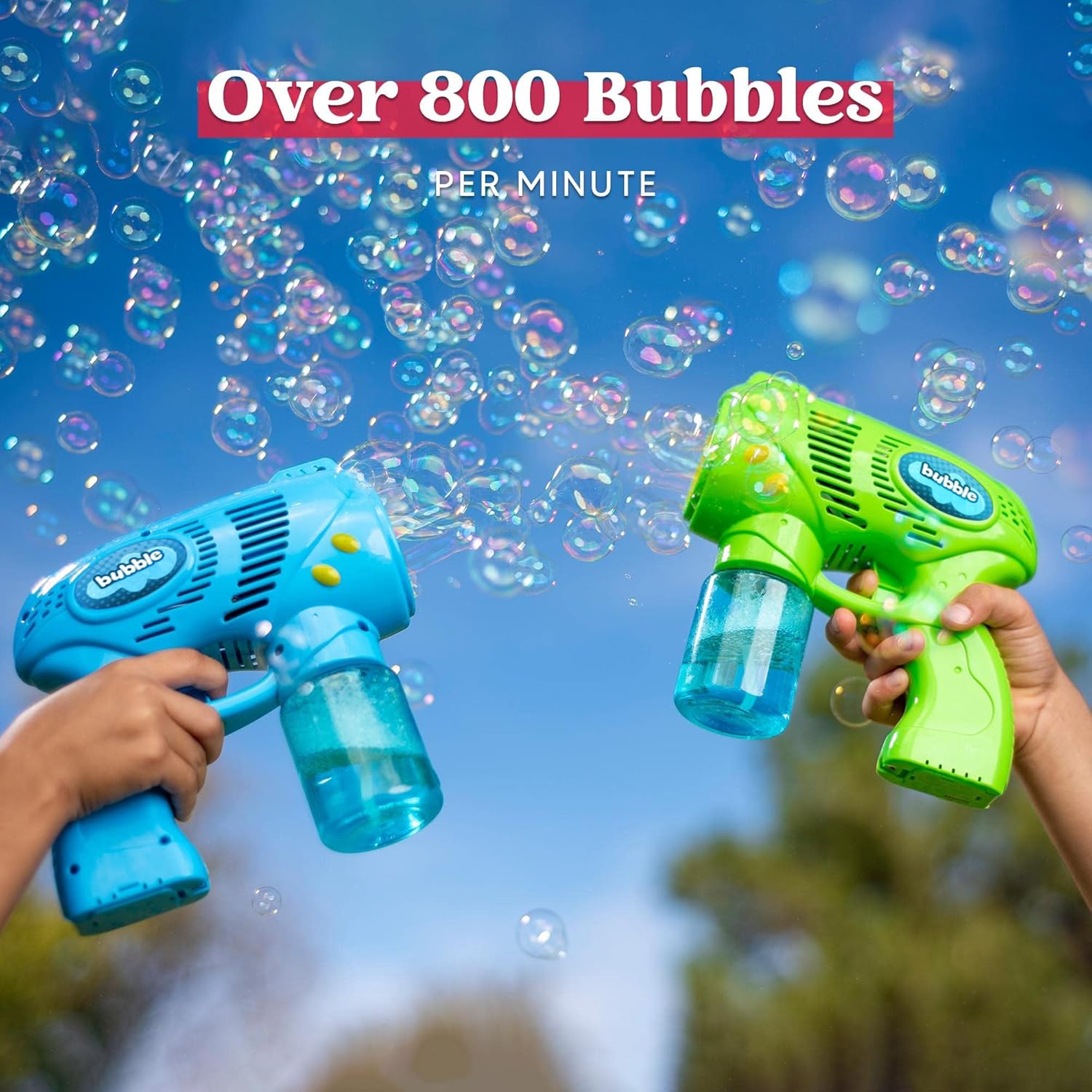
JOYIN
$23.99
In stock on Amazon
Check price on AmazonPetrella Rechargeable Bubble Gun — The Event-Frequency Premium
The Petrella rechargeable bubble gun represents a meaningful category departure from AA-or-D-cell models, and the math on this is worth laying out clearly for anyone running bubble guns more than occasionally.
A typical battery-powered bubble gun in the $20–$35 range consumes 2–4 AA batteries per session. At current retail, quality alkaline AA batteries run roughly $0.50–$0.75 per cell in bulk, which means $1.00–$3.00 per event in battery cost alone. For a household running weekly outdoor sessions from May through August — call it 16 sessions — that’s $16–$48 in batteries across a single summer, on top of the gun’s purchase price. Multiple reviewers across different battery-powered models cite ongoing battery cost and mid-session battery swaps as persistent frustrations, especially pointed at events where a coordinator managing a crowd of second-graders can’t stop to reload.
The Petrella rechargeable model eliminates that variable entirely. Owners report USB-C charging and sufficient battery life to cover a full outdoor session without a charge interruption. The tradeoff: higher upfront cost, and if the internal lithium-ion battery degrades after 300–500 charge cycles (a standard Li-ion lifespan), the gun becomes a more expensive disposal than a cheap battery-powered unit. For event-frequency buyers — anyone running the gun more than once a week through a season — the rechargeable math favors Petrella clearly. Wirecutter’s outdoor toys buyer’s guide (2025) specifically identifies rechargeable motors as a meaningful durability upgrade for high-frequency toy use, citing reduced thermal stress from consistent power delivery compared to alkaline batteries that sag in voltage as they discharge. For gift-givers buying a single gun for occasional backyard use, the premium is harder to justify.
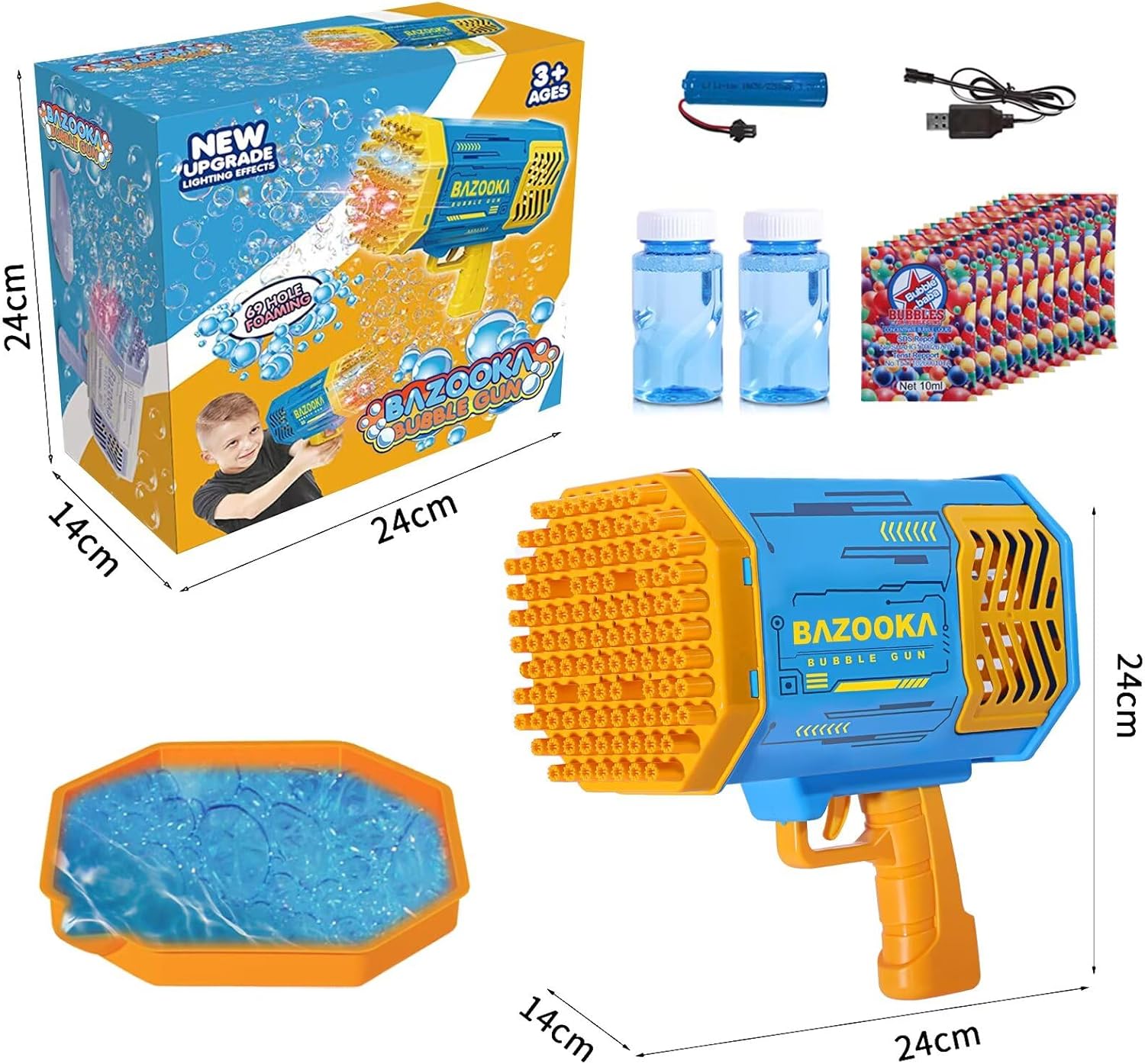
Bubble
$30.99
In stock on Amazon
Check price on AmazonThe JOYIN 3-Pack and ArtCreativity Bazooka: What to Avoid and Why
Two models in the category warrant specific caution, and understanding why protects you from the most common buyer regrets in this space.
The JOYIN 3-Pack value trap. The 3-pack looks like an obvious upgrade on paper: more units, seemingly similar construction, similar price per gun. The failure mode is invisible until unboxing. The yellow ring attachment — a decorative and functional element that connects the bubble wand assembly to the gun body — uses a connection point that reviewers describe as snapping on first use with normal handling. Several reviewers note that this failure is especially frustrating because it produces no warning in product photos or descriptions. The ring looks attached; it’s not robustly attached.
The decision rule here: if you need three guns, buy three 2-packs and keep one as a spare. The per-unit cost difference is small; the reliability difference is documented across multiple independent purchasers.
The ArtCreativity Bubble Bazooka wiring concern. A verified purchaser returned this model after documenting exposed wiring and internal components that raised safety concerns on visual inspection. We are reporting the purchaser’s documented experience, not making an independent electrical certification claim. The Spruce’s toy safety guidance recommends physically inspecting any battery-powered toy’s internal wiring before first use with children — a precaution that applies to all models but becomes the deciding factor here. Until the ArtCreativity Bazooka’s internal assembly quality is better documented across a larger review sample, we recommend against it for event use or unsupervised child play.
Frequently Asked Questions
Are bubble guns waterproof enough for kiddy pool or sprinkler play? Most are not rated waterproof — that distinction matters. “Splashproof” describes a different protection level than “waterproof.” The JOYIN 2-pack has an owner record of surviving splash-adjacent conditions, but that’s different from designed waterproofing. No consumer bubble gun in the $15–$50 range we’ve reviewed carries an IP waterproofing rating. Keep the gun body out of direct submersion; wand tips getting wet is normal and expected.
How long do batteries last in a typical bubble gun during outdoor use? Owner reports cluster around 1.5–3 hours of continuous use on fresh alkaline batteries, depending on motor size and hole count. High-hole-count bazooka designs draw more current and land on the shorter end of that range. Using carbon-zinc batteries instead of alkaline can cut that figure nearly in half.
What is the weakest point on most bubble guns? Ring and wand attachment points, followed by battery compartment doors. These two failure modes account for the majority of owner-reported failures across all models we reviewed. The wiring quality issue documented on the ArtCreativity Bazooka is a third category but appears less common across the broader field.
Do multi-hole bazooka guns actually produce more bubbles than standard wands? Yes, meaningfully so. Owners consistently report higher bubble density and visual output from multi-hole designs. The tradeoff is higher solution consumption and slightly more maintenance to prevent holes from clogging.
Are rechargeable bubble guns worth the extra cost? For frequent or event use — more than once per week through a season — yes. The break-even math typically favors rechargeable models within 6–8 sessions for a household that would otherwise buy quality alkaline batteries. For occasional or gift use, the premium is harder to justify.
What age are these bubble guns appropriate for? Most consumer bubble guns carry a manufacturer age recommendation of 3 and up, with adult supervision noted for younger children due to small parts and bubble solution ingestion risk. Event coordinators at school field days typically follow district toy-safety guidelines, which generally align with the 3+ manufacturer rating but recommend supervision under age 5.
The decision rule: If you’re buying for a single outdoor event or as a gift and durability is secondary to price, the JOYIN 2-pack is the documented safe choice in its tier. If you’re sourcing for recurring event use — field days, community booths, trunk-or-treats — the Petrella rechargeable model’s battery elimination and the JOYIN 8-hole’s bubble volume make them the practical workhorses, with the understanding that you’re buying a spare. Avoid the ArtCreativity Bubble Bazooka until its internal assembly quality is better established across a larger reviewer sample, and treat the JOYIN 3-pack as a value trap: the per-unit price looks right, but the ring attachment failure rate documented in verified owner reviews makes it the most disappointing buy in the category.