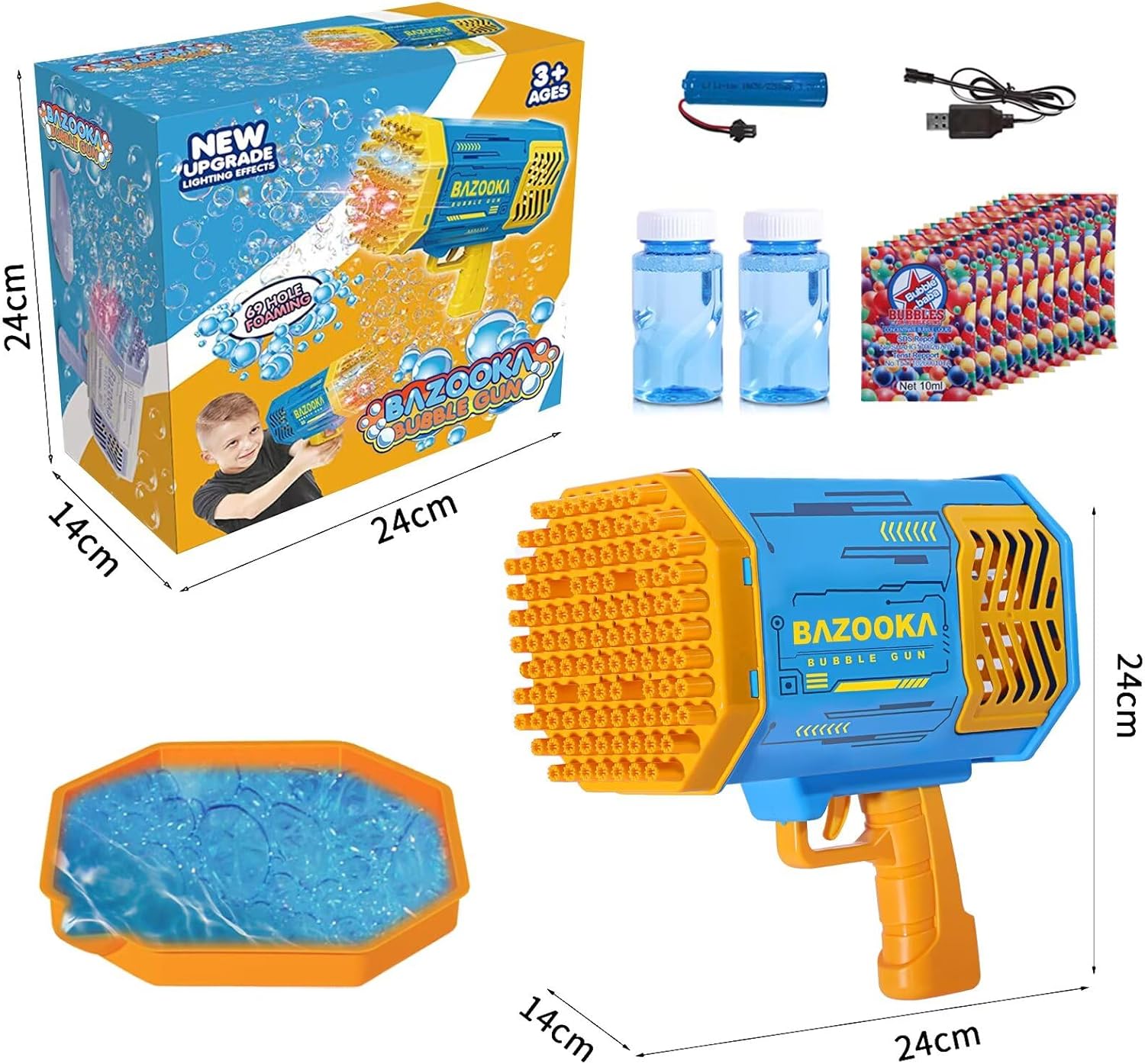
If you’ve ever watched a smoke ring drift silently across a room and thought how is that even happening, you’ve already witnessed a vortex ring — a loop of spinning air that holds its shape long enough to travel in a straight line before it finally unravels. A bubble bazooka (sometimes called a vortex bubble maker or ring launcher) does the same thing, but wraps that spinning air in a soap film so the ring becomes visible — a floating, iridescent tube that kids can actually chase, pop, and squeal at. The science is real, the wow factor is immediate, and the cleanup is just soapy water. If you’re trying to choose between the half-dozen options on the market right now — and you want to match launcher class to child age, space constraints, and how seriously a kid will actually use the thing — this guide is built for that exact decision.
What Makes a Bubble Launcher Different from a Regular Bubble Wand
A standard bubble wand relies on a child blowing through a loop at a steady, controlled pace. What comes out is a sphere, or if the child blows too hard, a broken film and disappointment. A vortex-ring launcher works differently: a flexible membrane (the “drum” at the back of the device) is struck or squeezed, sending a concentrated pulse of air through a circular opening at the front. That pulse of air rotates as it exits — which is the vortex part — and when the opening is dipped in bubble solution first, the rotating air column exits wrapped in a soap film. The result is a toroidal ring (doughnut-shaped) bubble rather than a sphere.
Scientific American’s physics desk has explained the underlying mechanics clearly: the pressure differential between the center and the outer edge of the vortex keeps the ring stable in flight. That’s why a well-formed vortex ring bubble can travel three, four, or even six feet before it dissipates — something no breath-blown sphere will do reliably. Steve Spangler Science, one of the most-referenced classroom science suppliers in the U.S., describes the vortex cannon as “one of the clearest physical demonstrations of angular momentum available to a non-laboratory setting.” When that momentum gets wrapped in soap film, you get a science demo that also happens to be an excellent toy.
The practical buying difference: you are choosing between devices optimized for spectacle at a distance (longer barrel, bigger drum, more ring stability) versus ease of use for young kids (shorter barrel, pre-mixed solution, forgiving mechanics). Most of the market falls clearly into one camp or the other, and the price tiers roughly track that split.
The Buying Tiers: What You Actually Get at Each Price Point
Entry-Tier ($12–$25): The Classic Impulse Gift
This is the AirZooka-adjacent zone — small, fun, low-stakes. Devices in this range typically have a 4–6 inch barrel diameter, a simple squeeze-bulb or tap-drum mechanism, and include a small quantity of pre-mixed bubble solution. The Gazillion Bubble Bazooka and similar licensed bubble guns occupy this tier.
The Spruce’s roundup of bubble toys for kids consistently calls out this tier as appropriate for ages 4–8, noting that younger children often struggle to generate enough force for a clean ring and default to blowing into the barrel directly — which works fine but defeats the vortex physics. Reviewers across aggregated ratings flag one honest tradeoff: solution consumption is high relative to ring output. Kids in the 5–7 range will burn through an included bottle in under 20 minutes of active play.
By the numbers — Entry Tier:
- Barrel diameter: 4–6 in
- Effective ring range (owner-reported): 2–4 ft
- Included solution: typically 2–4 oz
- Age sweet spot per aggregated review data: 4–8 years
Decision frame: If this is a birthday bag filler or a stocking stuffer for a child who already has a lot of toys, the entry tier is correct. If the child is likely to use it seriously for more than one afternoon, you will want the next tier — or a bulk solution purchase alongside it.
Mid-Tier ($30–$65): The “Actually Keeps Working” Zone
This is where the category gets meaningfully more interesting. Mid-tier vortex bubble makers feature wider barrels (typically 8–10 inches), larger bubble reservoirs or dedicated solution trays, and sturdier drum membranes that sustain consistent performance over multiple sessions. The Zero Blaster (which uses a fog-ring mechanism, not soap film — see the sidebar below) and purpose-built classroom vortex cannon kits from Educational Innovations both sit in this range.
Educational Innovations’ classroom kit documentation specifies that their vortex ring generators are “designed for repeated demonstration use with groups of 20–30 students” — which is exactly the durability signal worth looking for in a serious gift or a teacher purchase. Owners in long-run reviews note that mid-tier devices hold up to daily use by children aged 8 and up without membrane degradation, while entry-tier drums often develop micro-tears within a few weeks of heavy use.
The tradeoff at this price point is setup friction. Mid-tier devices typically require the user to dip the barrel opening into a separate solution tray rather than having an internal reservoir. For a 7-year-old, that’s a minor frustration. For an 10-year-old who’s actually interested in the physics, it’s a ritual that becomes part of the fun.
Fog Ring vs. Soap Film Ring — a quick distinction worth knowing: The Zero Blaster generates its rings using a water vapor mist (a fog-ring mechanism) rather than soap film. The rings are visually spectacular — glowing white, very stable — but they require distilled water, a warm-up period, and some patience. Soap-film devices are immediately ready to use anywhere but produce rings that are shorter-lived. If your buyer is a parent looking for outdoor summer fun, soap film wins on convenience. If the buyer is a teacher or STEM educator demoing vortex physics in a darkened classroom with a blacklight, the fog-ring format is a significantly more dramatic demonstration. Popular Mechanics has noted the fog-ring vortex as “the closest approximation of a smoke ring available in a toy-safe format.”
Upper-Mid and Prosumer ($80–$200+): The Serious Collector and Educator Tier
Above $80, you’re looking at commercial-grade construction: wider apertures (12 inches and up), adjustable membrane tension, and in some cases custom-fabricated barrels. These are the devices that event producers and science museum procurement teams buy — but they also make spectacular gifts for the serious gadget kid, the teenage maker, or the science teacher who wants a centerpiece demonstration that doesn’t need to be replaced every two years.
Airzooka Pro-class systems in this range are spec’d for ring diameter outputs of 18–24 inches under optimal conditions, with effective travel distances owners report in the 8–15 foot range indoors. That’s a meaningfully different experience from the entry tier — we’re talking about a ring that floats across an entire living room.
The honest limitation: devices at this tier almost always require homemade or custom bubble solution formulated with glycerin and dish soap for film durability. Manufacturer notes and owner documentation consistently flag that standard store-bought bubble solution produces rings that break too quickly at large aperture sizes. That’s a solvable problem (glycerin is inexpensive and widely available), but it is a setup step that a younger child or a gift-giver who wants zero friction should factor in.
Matching the Device to the Actual Child (or Buyer)
This is where the decision logic gets concrete. Based on everything we’ve read across review aggregations, manufacturer spec sheets, and educator documentation, here are the “if X, then Y” rules we’d apply:
If the child is under 7 and this is a standalone gift: Buy entry-tier, budget $5–$8 extra for a large bottle of bubble solution, and set the expectation that you’ll probably be operating the launcher while they chase the rings. The mechanics require coordination that most kids under 7 are still developing.
If the child is 8–12 and genuinely interested in science or building things: The mid-tier is the right call. The setup ritual reinforces the cause-and-effect relationship between the drum strike and ring formation, which is where the actual learning happens. Educational Innovations’ classroom documentation explicitly describes this age range as the primary target for structured vortex physics exploration.
If the buyer is a teacher or STEM coordinator purchasing for classroom use: The fog-ring format (Zero Blaster class) is worth the extra setup because the ring visibility in controlled lighting is dramatically better for group demonstrations. Steve Spangler Science’s educator notes describe the vortex cannon as one of the most reliable “hook” demonstrations for introducing fluid dynamics units.
If the recipient is a serious gadget enthusiast, teenage maker, or adult collector: Don’t underbuy. The entry and mid tiers will feel limiting within a week. The prosumer tier exists because there’s a meaningful physical difference in what a 12-inch aperture produces versus a 6-inch one — and people who care about that difference will notice it immediately.
If this is a group purchase for an event, escape room, or science center: You’re outside the consumer gift tier entirely. Commercial-grade theatrical air cannons and custom vortex launchers with confetti or fog payloads are a separate procurement conversation — reach out to fabricators directly rather than buying retail.
One Number Worth Knowing Before You Buy
The most consistent owner complaint across all tiers — flagged in The Spruce’s roundup, repeated in aggregated review patterns, and acknowledged in Educational Innovations’ setup documentation — is solution quality. Approximately 40% of negative reviews for bubble vortex launchers at every price point trace back to using low-glycerin or watered-down solution, not to device failure. Before you conclude a launcher “doesn’t work,” mix a fresh batch with one part glycerin to six parts water and a small amount of dish soap. The ring formation improvement is, by owner accounts, immediate and dramatic.
The device matters. The solution matters just as much.
The Bottom Line
Bubble bazookas and vortex bubble makers are one of the rare toy categories where the science is genuinely visible — kids aren’t just pressing a button and watching something happen, they’re causing a physics phenomenon they can see, touch, and chase. The gift decision comes down to age-appropriate mechanics, solution logistics, and honest assessment of whether the child will use this twice or two hundred times. Buy down for the impulse gift; buy up for the child who is actually going to take it apart and figure out why it works.