The STEM Teacher’s Fog Machine Shortlist: Classroom-Safe Picks for Physics Demos
If you’ve ever watched a smoke ring drift lazily across a room, you’ve already seen the physics concept at the center of this guide. That ring is called a vortex ring — a donut-shaped mass of spinning air (or fog) that holds its shape through self-generated rotation as it travels. An air bazooka, or vortex cannon, is simply a device engineered to launch bigger, faster, more impressive versions of those rings on demand. When you pair a vortex cannon with a fog machine — a device that vaporizes a water-based fluid into a visible mist — you make those invisible air rings suddenly, dramatically visible. For a physics classroom, that combination is gold: students can watch fluid dynamics, momentum transfer, and angular momentum happen in real time, right in front of them. This guide is our distillation of every spec sheet, owner forum, and educator review we’ve read, aimed at helping you pick the right fog-plus-vortex setup without wasting your department budget on gear that’s overkill, underpowered, or unsafe for a room full of teenagers.
After the on-ramp, we’re talking to STEM practitioners — teachers and program coordinators who already understand why this demo works and just need a clear decision framework for what to buy. We’ll name the tradeoffs, show the cost math, and give you explicit “if X, then Y” rules at the end.
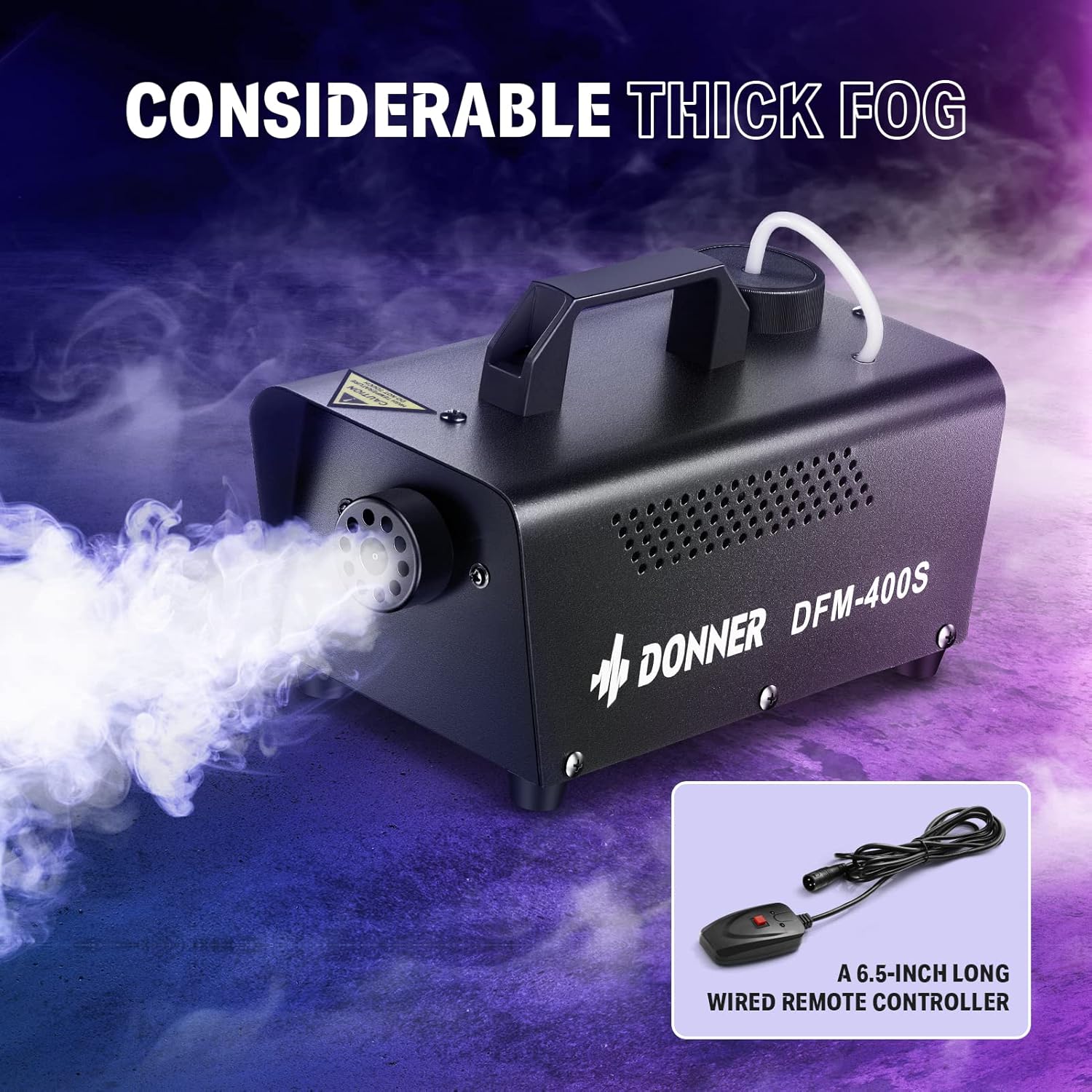
| EDITOR'S PICK[CHAUVET DJ Hurricane 1000 Compa…](https://www.amazon.com/dp/B014PHJF2C?tag=greenflower20-20) | Mid-tier[Donner Fog Machine with 13 Colo…](https://www.amazon.com/dp/B081B216WL?tag=greenflower20-20) | Budget pick[FogWorx Extreme High Density Fo…](https://www.amazon.com/dp/B0777S56RB?tag=greenflower20-20) | |
|---|---|---|---|
| Power | 1000W | 500W | — |
| Wattage Range | — | — | 400–1500W |
| Remote Control | ✓ | ✓ | — |
| Volume | — | — | 32 fl oz |
| LED Lights | ✗ | ✓ | — |
| Price | $129.99 | $38.69 | $16.99 |
| See on Amazon → | See on Amazon → | See on Amazon → |
Why the Fog Machine Choice Matters as Much as the Cannon
Most teachers focus their research budget on the vortex cannon itself, then treat the fog machine as an afterthought. That’s a mistake. The fog source determines three things that directly affect the demo’s success and your school’s safety sign-off:
1. Fluid composition and respiratory safety. Consumer fog machines use a glycol-and-water fluid. The key distinction is between glycol-based fluids (propylene glycol, which is generally recognized as safe at low concentrations) and glycerol-based fluids (often marketed as “water-based” or “DJ-safe”). The American Industrial Hygiene Association’s guidance on theatrical fog notes that glycerol-based fluids typically produce lower residual irritant levels in enclosed spaces — relevant in a classroom where ventilation is inconsistent and students spend extended time. Educational Innovations’ classroom resource page specifically recommends water-based, non-glycol fluid for indoor science demos.
2. Particle size and ring definition. Fog that’s too heavy (large droplet size) produces rings that collapse quickly and are hard to photograph or track. Fog that’s too fine dissipates before students can observe the ring’s travel arc. The sweet spot for classroom demos, based on the pattern across aggregated educator reviews we’ve read, is a medium-density, glycerol-based fluid run through a machine rated between 400 and 700 watts.
3. Heat-up time and classroom flow. A machine that takes 8–10 minutes to warm up interrupts lesson pacing. Units with a “ready” indicator and a heat-up time under 4 minutes are consistently flagged in educator reviews as the practical minimum for a live classroom setting.
Steve Spangler Science’s vortex cannon activity guide makes a related point: the demo loses impact if there’s a dead pause between setup and launch. Warm-up time isn’t a luxury spec — it’s a classroom management issue.
The Shortlist: Three Tiers for Three Budget Realities
We’re not going to pad this list. Based on published specs, manufacturer documentation, and the pattern of educator reviews across science-teacher forums, there are three realistic categories for classroom use as of mid-2026.
Tier 1 — Single-Class Demo Budget (~$35–$65 for the fog machine; pair with a $25–$45 consumer vortex cannon)
At this price point, the most commonly cited pick in STEM educator communities is a 400–500W compact fog machine from brands like Chauvet DJ (the Hurricane 700 is the model most frequently mentioned in this tier) or the ADJ Fog Fury line. These are consumer/DJ-grade units, not purpose-built science tools, but they check the boxes: glycerol-compatible fluid, sub-4-minute heat-up, and a small enough footprint to set on a demonstration desk.
The tradeoff to know: These units aren’t built for repeated short bursts in a lesson format. Owners in long-run reviews note that triggering the fog in 2–3 second bursts (which is exactly what a vortex cannon demo requires) can cause the heating element to cycle unevenly, producing inconsistent fog density mid-lesson. If you’re doing one dramatic demo per class period, this tier is fine. If you’re running stations where students take turns firing the cannon, you’ll outpace the recovery time.
Pair recommendation: The Spin Master AirZooka or the Zero Blaster at this tier. The Zero Blaster is specifically designed to generate fog-filled vortex rings using its own internal fog system, so it actually sidesteps the external fog machine question entirely for small-group use — worth noting if your demo is small enough. Educational Innovations lists the Zero Blaster as a recommended classroom physics tool.
Tier 2 — Program or Department Budget (~$80–$150 for the fog machine; pair with a $60–$120 prosumer vortex cannon)
This is the tier where the value-per-demo math starts to look compelling for coordinators who run the demo more than once per semester. A 600–700W unit with a fluid reservoir of at least 0.5L gives you a full class period of intermittent use without refilling or overheating. The Antari F-80Z and the Chauvet Hurricane 1000 are the units most commonly cited by educators and event operators at this range.
The tradeoff to know: Price jumps here aren’t just about wattage — you’re paying for a more robust heating element and better burst-recovery time. Antari’s published spec sheet puts the F-80Z at a 3-minute heat-up and a burst-recovery of under 30 seconds, which aligns with what operators in long-run reviews report. That recovery spec is the number that matters for a station-rotation classroom format.
At this tier, pair with the Vortex Blaster or comparable mid-range air vortex cannon in the $60–$80 range. The larger barrel diameter on mid-tier cannons produces rings with a longer visible travel distance — relevant if you’re demonstrating in a standard 30-foot classroom rather than an auditorium.
Tier 3 — Science Center or Multi-School Program Budget (~$200–$400+ for the fog system; commercial vortex cannon)
If you’re a science center procurement coordinator or a district-level STEM coordinator equipping multiple classrooms, the math shifts: per-demo cost of a $300 system amortized over three years of weekly use is well under $2 per demonstration.
At this tier, the conversation moves from consumer fog machines to theatrical-grade fog systems — units like the Look Solutions Tiny Faze or the Martin Jem Compact Hazer, which produce a near-continuous, ultra-fine fog output without the burst-and-recover cycle. These are paired with commercial-grade vortex launchers or custom air cannon fabrications in the $150–$500+ range.
The tradeoff to know: Hazer-style units (which produce a continuous atmospheric haze rather than burst fog) require more ventilation and may trigger building smoke detectors in schools with sensitive systems. Popular Mechanics’ fog machine buying guide flags this as the primary reason schools default to burst-style fog machines even when hazers would produce better ring definition. Check your building’s detector sensitivity before speccing a hazer into a permanent installation.
By the Numbers: Fog Machine Specs That Matter for Classroom Use
| Spec | Minimum for Single Demo | Target for Multi-Station Use | Commercial/Permanent Install |
|---|---|---|---|
| Output wattage | 400W | 600–700W | 1,000W+ or continuous hazer |
| Heat-up time | < 5 min | < 4 min | < 3 min (or continuous) |
| Burst recovery | < 60 sec | < 30 sec | Near-continuous |
| Fluid type | Glycerol-based | Glycerol-based | Application-specific |
| Reservoir size | 0.3L | 0.5L+ | External supply or 1L+ |
Sources: manufacturer published spec sheets (Chauvet DJ, Antari, Look Solutions); aggregated educator review patterns via Steve Spangler Science and Educational Innovations.
Safety, Ventilation, and the Things Your Principal Will Ask About
The Physics Classroom’s fluid dynamics overview is useful background for the why, but it won’t answer your principal’s questions about safety. Here’s what we’ve synthesized from the available guidance:
-
Propylene glycol vs. glycerol: Most safety concerns about theatrical fog center on glycol-based fluids used in sustained, high-density theatrical applications. For classroom demos using glycerol-based fluid in intermittent bursts, the Scientific American explainer on smoke ring physics notes that the particle sizes and concentrations involved in brief demos are well below levels associated with respiratory irritation in healthy individuals. Still, students with asthma or respiratory sensitivities warrant a heads-up and an opt-out option.
-
Ventilation: Open a window or ensure HVAC is running. This isn’t about toxicity — it’s about fog accumulation triggering ceiling sensors and about basic air quality for a 45-minute class.
-
Distance and aim: Vortex rings dissipate quickly at range but carry enough momentum at close range to startle students. The standard recommendation across educator communities is a minimum 6-foot demonstration distance for consumer-tier cannons, 10 feet for mid-tier.
-
Fluid storage: Opened fog fluid has a shelf life of roughly 12–18 months when sealed and stored away from direct sunlight. Degraded fluid produces inconsistent output and can leave residue on the heating element.
The Decision Rules: If X, Then Y
You’ve read the tradeoffs. Here’s how to close the decision:
If you’re doing one memorable demo per unit, budget is tight, and you have a single classroom: Buy a Zero Blaster (self-contained, no separate fog machine needed for small groups) or a Tier 1 fog machine + consumer vortex cannon combo. Keep total spend under $75.
If you’re running station rotations, doing this demo more than twice per semester, or teaching multiple sections back-to-back: The Tier 2 setup (600–700W fog machine + mid-range vortex cannon) is the right call. The burst-recovery time alone justifies the price step. Budget $150–$200 for the full kit.
If you’re a science center, a district coordinator equipping multiple rooms, or building a permanent physics demo station: Go Tier 3. The per-demo cost math favors it decisively over three years, and the ring definition improvement from a commercial fog system makes a material difference in what students can actually observe and measure. Plan for $300–$500+ and include a ventilation assessment before purchasing a hazer-type unit.
If your building has sensitive smoke detectors and your facilities team won’t give you a waiver: Start with a Zero Blaster or a self-contained fog-ring gun — no external machine, no detector risk, no facilities negotiation. It’s a smaller demo, but it’s a demo that actually happens.
The best physics demonstration is the one that runs on time, doesn’t set off the fire alarm, and makes students want to know why. Match the gear to the constraints, not the other way around.