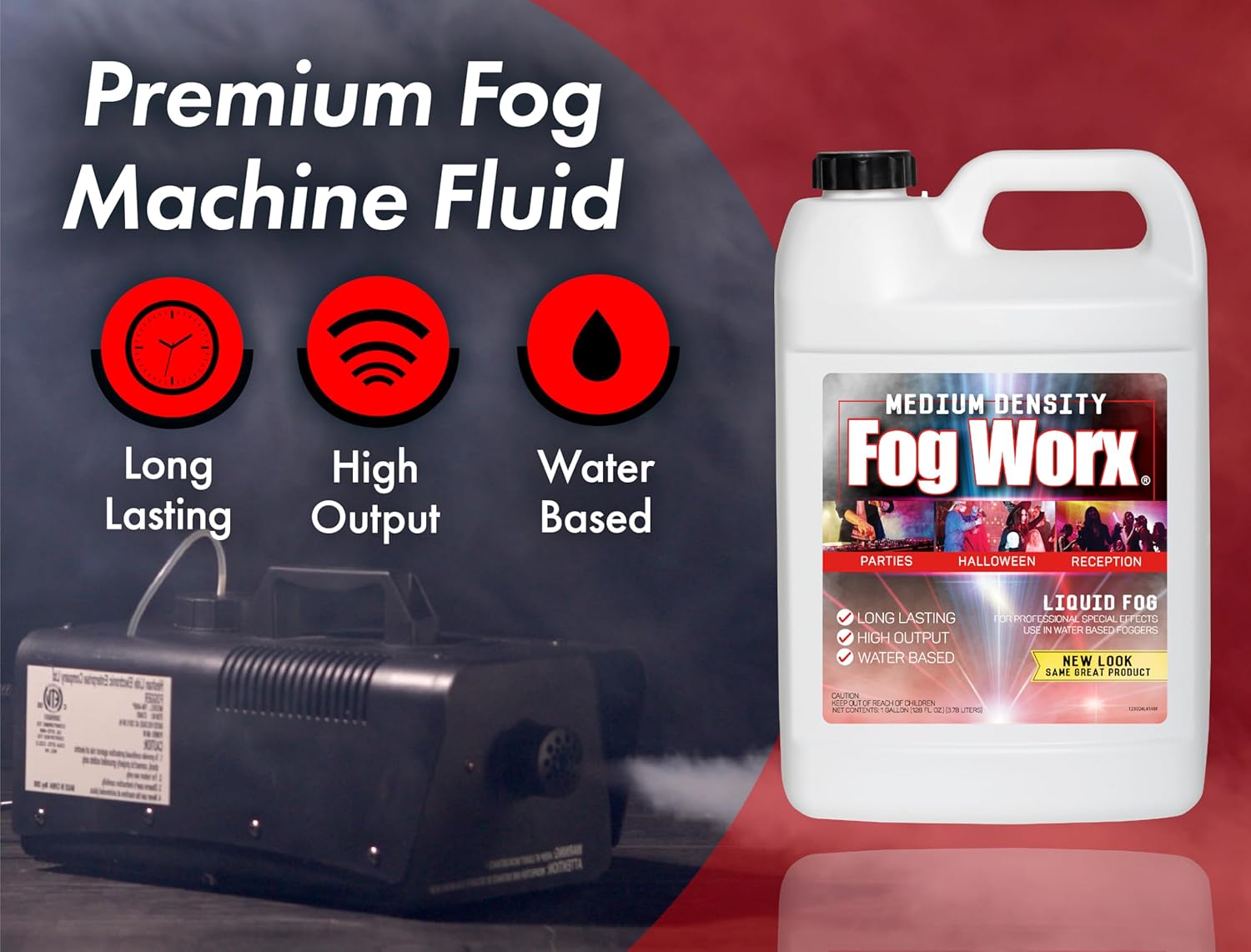
If you’ve ever watched a vortex ring launcher — the kind that fires a rolling, donut-shaped pulse of air across a room — produce those crisp, slow-tumbling smoke rings, you’ve already seen fog fluid doing its job. Fog fluid (sometimes called “haze fluid” or “smoke juice”) is a water-and-glycol mixture that a fog machine vaporizes into a thick white mist. That mist is what makes an otherwise invisible air vortex visible: the ring captures the fog and carries it intact across the room, sometimes fifteen or twenty feet. Without fluid, you get a strong invisible puff of air. With it, you get a visual effect that stops people in their tracks.
If you’re running a vortex launcher occasionally — at a birthday party, in a classroom demo — a single quart bottle you grab online works perfectly well. But if you’re operating regularly — escape rooms, science-center exhibits, theatrical productions, recurring STEM events — that per-quart price adds up fast. This guide is about closing that gap: running the cost-per-hour math, choosing the right fluid type for ring definition, and making a defensible bulk-purchase decision before you commit.
| EDITOR'S PICK[Code 6 Premium Fog Fluid – Long…](https://www.amazon.com/dp/B007OLR20O?tag=greenflower20-20) | Mid-tierFroggy's Fog Swamp Juice Bottle | Budget pick[CHAUVET DJ FJ-U Fog Fluid](https://www.amazon.com/dp/B0002NRMLK?tag=greenflower20-20) | |
|---|---|---|---|
| Hang Time | — | 2-3 hr | — |
| Machine Compat. | 400-1500W | — | — |
| Fluid Type | Water-based | — | Standard |
| Price | $34.99 | $29.99 | $20.95 |
| See on Amazon → | See on Amazon → | See on Amazon → |
Why Fluid Type Matters Before You Talk Price
Not all fog fluid performs the same way in a vortex ring context, and choosing the wrong type on price alone is the most common expensive mistake we see intermediate operators make.
Fog fluids generally fall into three performance categories, and each has a different consumption rate and visual output that affects your real cost calculation:
Standard/water-based fog fluid produces a dense, opaque output and dissipates relatively quickly — typically within 30 to 90 seconds depending on airflow and room humidity. For vortex ring use, this is actually a feature: the ring stays visible for its full travel arc but doesn’t linger as a cloud that fills the room and obscures the next shot. Popular Mechanics’ explainer on fog machine mechanics notes that standard glycol-water fluids atomize cleanly at lower heater temperatures, which is why they’re compatible with a wide range of consumer and prosumer fog machines.
Haze fluid is formulated for long hang time — it can stay suspended in air for many minutes. Scientific American’s coverage of vortex ring physics points out that ring integrity depends on fluid density and viscosity within the vortex core: lighter, fine-particle haze fluid produces a less visually defined ring at launch, though it sustains the ring’s visible trail over longer distances. High-end stage operators sometimes layer haze fluid (ambient) with a standard fluid burst (ring definition), which requires either two machines or a switchable fluid system.
Glycerin-heavy formulas (sometimes marketed as “thick” or “maximum output” fluids) produce the densest, most opaque output per milliliter of fluid consumed. They’re the choice for dramatic, high-visibility rings in larger venues — science centers, escape-room grand chambers, event stages — but they come with trade-offs: residue accumulation in machine heating elements is faster, and some formulas require higher heater temperatures that not all consumer fog machines can sustain. Froggy’s Fog’s product comparison sheet for their Hang Time and Intense series explicitly lists compatible machine heater wattage ranges alongside consumption data, which is exactly the kind of spec to cross-reference before ordering.
Decision rule here: If your primary metric is ring definition at distances under 20 feet in an indoor, low-airflow environment, standard water-based fluid from a reputable brand is almost always the right choice and the most cost-effective. If you’re working at 25+ feet, in a larger venue, or for theatrical staging where the ring needs to travel through ambient light beams, a glycerin-heavy formula earns its higher per-gallon cost.
Running the Cost-Per-Hour Math
This is where intermediate operators often stop too early — they compare the per-gallon sticker price between bulk tiers and call it done. But consumption rate and output quality fold into the real number.
Here’s the baseline math structure we use when aggregating operator reports:
Variables you need:
- Fluid consumption rate of your fog machine (in milliliters per minute, or mL/min) — this is on your machine’s spec sheet
- Estimated operating minutes per event or per hour
- Cost per gallon of fluid at each purchase tier
By the Numbers
| Purchase tier | Typical price per gallon (May 2026) | Cost per 100 mL |
|---|---|---|
| Single quart (0.25 gal) | ~$14–$18 equivalent | ~$0.37–$0.47 |
| Single gallon | ~$22–$32 | ~$0.58–$0.85 |
| 4-gallon case | ~$18–$24/gal | ~$0.47–$0.63 |
| 5-gallon drum | ~$14–$19/gal | ~$0.37–$0.50 |
Prices aggregated from published retail listings and operator forum reports as of Q2 2026. Specific brand pricing varies; these are representative ranges for water-based standard fluid from established US suppliers.
A mid-range fog machine running at a typical 40–60 mL/min consumption rate (manufacturer-rated, per Look Solutions’ technical specification documentation for their prosumer line) will burn through roughly 2.4–3.6 liters (about 0.6–0.95 gallons) in an hour of continuous operation.
That means:
- Single-quart buyer running 3 hours of events per week: ~$0.42/100 mL × 3 liters/hour × 3 hours/week ≈ ~$3.78/week in fluid costs, or roughly $197/year
- 5-gallon drum buyer, same usage: ~$0.44/100 mL × same consumption ≈ ~$3.96/week — but they’re paying less per gallon and spending less labor time on reorders
- High-consumption operator (escape room, 8 hours/day, lower-rate machine): fluid cost can reach $800–$1,400/year — at which point the drum tier or direct-from-manufacturer wholesale pricing becomes a straightforward financial decision
The crossover point — where a 4-gallon case beats single gallons — is typically around 6–8 gallons of annual consumption. Below that, the shelf-life question (more on this below) may actually work against bulk buying.
The Shelf-Life Constraint Most Operators Underestimate
Fog fluid doesn’t last forever, and this is the variable that makes bulk buying a real decision rather than an obvious one.
Most water-based fog fluids carry a manufacturer-recommended shelf life of 12–24 months when stored sealed in a cool, dark environment. Froggy’s Fog’s technical documentation specifically recommends storage below 80°F and away from UV light, noting that glycol oxidation can degrade fluid performance — producing less consistent output and, in some cases, leaving more residue in machine heating elements.
For a classroom operator running monthly demonstrations or a part-time escape room operator running weekends only, buying a 5-gallon drum means you might be on a 2–3 year consumption schedule — pushing past that recommended window. In that case, splitting a case order with another operator (a tactic that comes up regularly in Vortex Cannon Facebook group discussions, per aggregated operator reports) or stepping down to a 4-gallon case is the smarter move.
For daily-use commercial operators — science centers, theatrical productions with multi-week runs — a drum purchase is almost always justified by both math and logistics.
Decision rule: Estimate your annual fluid consumption honestly. If you’ll use a 5-gallon drum within 18 months, buy the drum. If it would take you 2+ years, buy a case or split a drum order. The per-gallon savings don’t offset degraded performance and potential machine maintenance costs from aged fluid.
Fluid-to-Machine Compatibility: The Check You Can’t Skip
Educational Innovations’ educator FAQ for their classroom fog ring kit explicitly flags this: not all fog fluids are safe to run in all machines. The heating element temperature and the fluid’s glycol concentration need to match. Running a high-glycerin formula through a machine rated for standard fluid can leave carbonized residue that shortens heater life — the kind of damage that voids warranties and generates forum complaints.
Before committing to any bulk order:
- Find your machine’s rated fluid type — this is in the manual or on the manufacturer’s product page. Look for language like “water-based standard fluid,” “haze fluid only,” or “professional glycerin-compatible.”
- Match the fluid’s stated compatible machine wattage — Look Solutions’ tech spec sheets list minimum heater wattage requirements alongside each fluid SKU. This is the right model for how to read any reputable fluid manufacturer’s documentation.
- Run a one-gallon test before committing to a case or drum — if you’re switching fluid brands or formulas, one gallon gives you enough operating time (typically 2–4 hours on a mid-range machine) to confirm output quality and check for residue. Operators in long-run reviews consistently report that this single step saves more than it costs.
Sourcing Channels and What to Watch in 2026
As of Q2 2026, the primary reliable sourcing channels for bulk fog fluid in North America are direct-from-manufacturer web stores (Froggys Fog, Froggy’s Fog, American DJ Fluid line, Look Solutions), theatrical supply distributors, and event production equipment dealers. These channels offer the most consistent formulation quality and the clearest shelf-life documentation.
A few patterns worth flagging from operator community reports:
- Generic/unbranded bulk fluid sourced through non-theatrical channels has generated recurring complaints about inconsistent viscosity, faster residue buildup, and occasional off-gassing odors during operation. The per-gallon price looks attractive; the downstream machine maintenance cost often isn’t.
- Shipping cost is a real factor at the gallon-and-above tier. Fog fluid is heavy (water-glycol solutions run roughly 8–9 lbs per gallon). A 5-gallon drum can add $20–$40 in freight. Always calculate landed cost (fluid price + shipping) before comparing tiers.
- Regional theatrical distributors sometimes offer walk-in or local-delivery pricing that undercuts online retail, especially if you’re buying a case or more. If you’re in a major metro, it’s worth a call.
The Decision Framework
Here’s the if/then map we’d walk through before placing a bulk fog fluid order:
- If you operate fewer than 4 hours/month → buy single gallons, skip the bulk math entirely
- If you operate 4–15 hours/month and have verified machine compatibility → a 4-gallon case is almost always the right move; run the 18-month consumption check to confirm you’ll use it within shelf life
- If you operate daily or run multi-week theatrical or commercial installations → a 5-gallon drum at a trusted manufacturer tier is the clear call; confirm landed cost including freight
- If you’re switching fluid formulas for the first time → buy one gallon first, run 2–3 hours, inspect the machine’s output consistency and residue level before committing to bulk
- If your venue is temperature-variable (outdoor events, non-climate-controlled storage) → factor in the shelf-life constraint aggressively; heat and UV exposure are the primary degradation drivers
The math is genuinely straightforward once you have your machine’s consumption rate and your honest operating-hours estimate. The operators who overpay — or end up with degraded fluid and a sticky heating element — are almost always the ones who skipped one of those two inputs. Run the numbers with your actual usage, match to the right formula for your launcher and venue, and the bulk tier that’s right for you becomes obvious.