If you’ve ever watched a music video and wondered how the artist seems to float inside a soft, glowing cloud — or how a photographer gets that cinematic haze that makes a portrait look like it belongs on a movie poster — you’ve already seen a handheld fog machine at work. These are compact, often battery-powered devices that heat a water-based fluid (sometimes called “fog juice” or “haze fluid”) and push it out as a fine mist or a dense cloud. The difference between a great atmospheric effect and a ruined shot often comes down to which machine you’re holding and whether it’s dialed in for your specific context.
This guide is for the photographer who just booked their third paid shoot and wants to stop borrowing gear, the vlogger who’s tired of fog that blurs the subject instead of framing them, and the mobile DJ who needs big-moment impact without hauling CO₂ tanks. We’ve read every spec sheet, owner thread, and comparative review we could find — here’s what the pattern looks like from the outside.
Haze vs. Fog: The Tradeoff That Changes Everything
Before we compare units, let’s name the core tradeoff, because getting this wrong means buying the wrong machine.
Haze (sometimes called “atmospheric haze”) produces an ultra-fine, near-invisible suspended mist. The particles are small enough that they scatter light beams — laser beams, stage lights, sunlight through a window — without coating a surface or making your subject look foggy. This is what you want for photography and video if the effect is the light, not the cloud itself.
Fog produces denser, more visible clouds of larger particles. It’s what fills a stage, creates a horror-movie ambiance, or — at full blast from a high-wattage unit — gives a DJ set that “big moment” explosion effect. The tradeoff: at close range or in a confined space, fog can absolutely blur a camera subject or overwhelm a shot.
Owner reviews make this tension explicit. Multiple PMI SmokeNINJA Pro reviewers describe their previous units (specifically naming LensGo and Ulanzi handheld fog devices) as producing fog that was “chunky” and “overwhelming” — their word — at typical shooting distances. The SmokeNINJA Pro’s finer, more consistent haze output is the reason they switched. That single word, “chunky,” tells you exactly what’s at stake: particle size is the functional variable.
The decision frame here is simple: If you’re shooting video or stills where the camera is within 3–8 feet of the effect, you almost always want a haze-tuned machine. If you’re filling a room or creating a dramatic DJ entrance, you want fog volume and wattage, and camera blur is a feature, not a bug.
Four Units Worth Understanding (And What They’re Actually Good For)
PMI SmokeNINJA Pro — The Photographer’s Haze Tool
This is the one that keeps coming up in comparative reviews for on-camera work. Multiple owners explicitly describe replacing LensGo and Ulanzi units with the SmokeNINJA Pro, and the pattern is consistent: better build quality, a non-leaking fog chamber design, and output fine enough that it doesn’t blow out the foreground of a shot.
The “non-leaking” detail matters more than it sounds. Cheaper handheld units commonly drip residual fluid when tilted or stored between takes — reviewers describe discovering oil-stained bags and wet camera cases. The SmokeNINJA Pro’s chamber design is specifically called out as solving this.
Where it earns its place: Portrait sessions, music video B-roll, lifestyle vlogging where the fog is a background texture, not the subject.
Where it doesn’t: It’s not a high-volume room-filler. If you need to fog a 30×40 foot warehouse, this isn’t your tool.
Fluid compatibility note: Owners report success with third-party water-based fog fluids, though PMI’s documentation recommends their branded fluid for warranty coverage. We address this more in the FAQ section below.
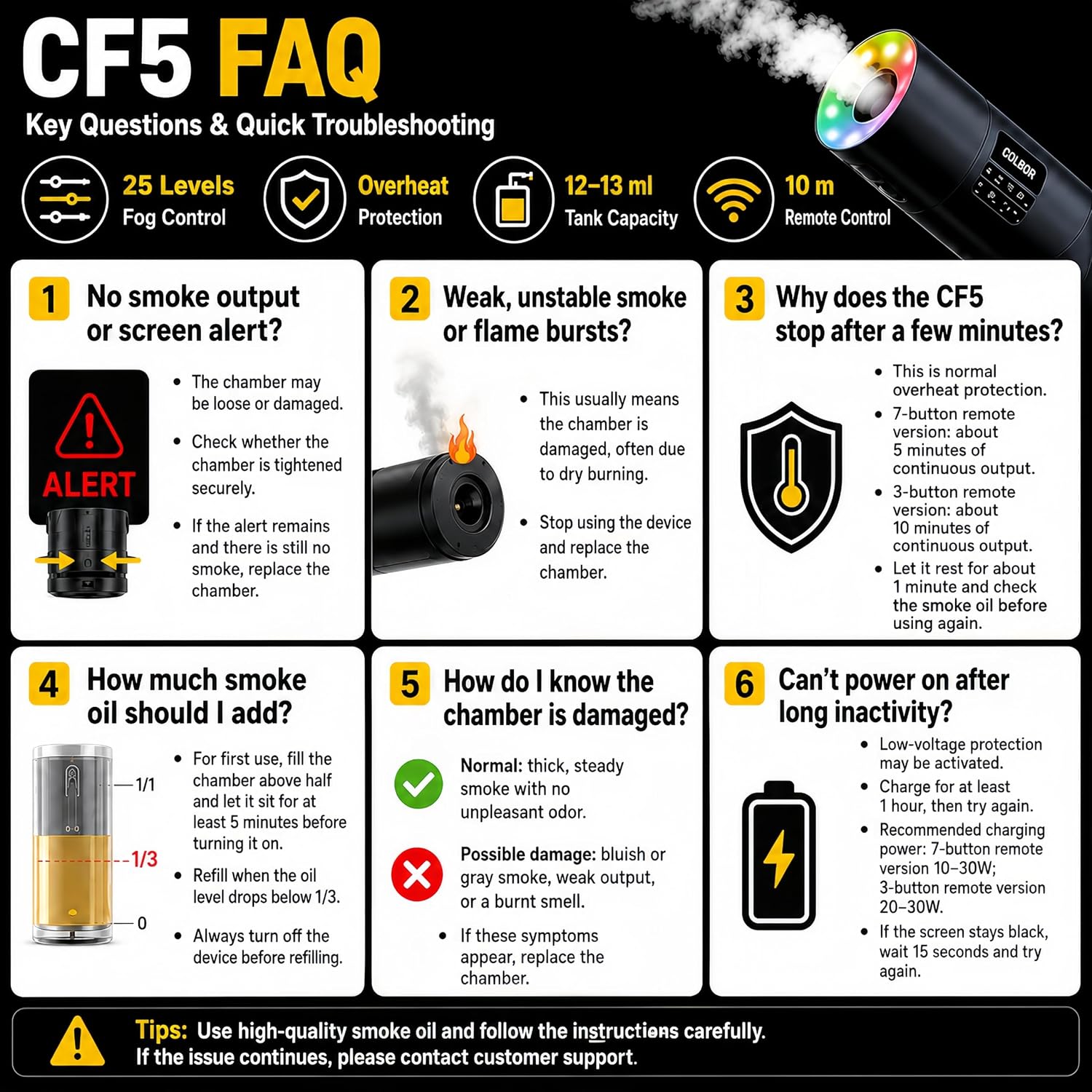
Colbor CF5 — The Honest Niche Product
One Colbor CF5 reviewer does something rare: they explicitly call it “a niche product” and add that if all you need is fog without integrated color effects, you can spend less. That kind of self-aware honesty from a buyer who still recommends the unit is a strong signal.
The CF5’s differentiator is its integrated RGB light output — it produces colored haze, not just white. For vloggers building atmospheric B-roll with specific color grading in mind, or for photographers who want the effect to carry its own visual weight without additional gels or lights, that integration is genuinely useful.
The tradeoff: You’re paying for the RGB system even if you only use white mode 80% of the time. The honest framing from reviewers — “spend less if color doesn’t matter” — should be taken seriously. This is a splurge that makes sense if color-in-haze is a recurring part of your creative language.
1500W Handheld Fog Cannon — DJ Big-Moment Tool
This is a categorically different product in the same physical format. At 1,500 watts, this is not a subtle-atmosphere machine. DJ-use reviews describe it specifically as a “big moment” device — the kind of unit you point at the crowd during a drop, not something you set and forget.
The practical win reviewers highlight: no CO₂ setup required. For mobile DJs who’ve dealt with CO₂ tank logistics (sourcing, transport regulations, venue restrictions), a plug-in electric unit that delivers comparable visual impact removes real operational friction.
The indoor question: Is 1,500W too much for indoor DJ events? Reviewers say it depends almost entirely on room size and ventilation. A 200-person venue with standard HVAC handles it. A small bar or private event space gets saturated fast. We address this directly in the FAQ.
It’s not a photography tool. At this output level and particle density, camera use within the fog output zone is not what this machine is designed for.
JDR 500W Portable Machine — The Tinkerer’s Platform
The JDR 500W reviews reveal a creative angle that the other units don’t: at least one owner documented combining it with an ultrasonic mister (a device that uses high-frequency vibration to turn water into a cold, ground-hugging mist) to build a custom low-fog rig. That kind of DIY extension isn’t accidental — portable machines at this wattage attract buyers who want a platform, not just an appliance.
For intermediate practitioners who are comfortable modifying a rig or building multi-component setups, the JDR 500W sits in an interesting price-to-hackability position. It’s not the most polished unit in its class, but its output and form factor make it a useful base layer.
By the Numbers
| Unit | Wattage | Primary Use Case | Battery/Power | Leak Reports |
|---|---|---|---|---|
| PMI SmokeNINJA Pro | ~30–50W (handheld) | Photography / video haze | Rechargeable battery | Low (chamber design cited) |
| Colbor CF5 | ~30W (handheld) | Colored haze, vlogging | Rechargeable battery | Not a recurring complaint |
| 1500W Fog Cannon | 1,500W | DJ / event big moments | AC power (plug-in) | Not applicable (stationary use) |
| JDR 500W Portable | 500W | General / DIY platform | AC power (portable) | Some noted at fluid port |
Making the Decision: If X, Then Y
This is where we try to save you the 45-minute research loop.
If you’re a photographer or vlogger shooting within 10 feet of the effect and subject clarity matters: The PMI SmokeNINJA Pro is the unit the community keeps converging on after trying cheaper alternatives. The finer output and non-leaking design solve the two problems that bite people most.
If color-integrated atmosphere is part of your visual identity and you’re willing to pay for that integration: The Colbor CF5 earns its premium, but go in knowing it’s a niche spend. The reviewer who called it a niche product was right and was still glad they bought it — that’s the relevant data point.
If you’re a mobile DJ who needs big-moment visual impact without CO₂ logistics: The 1500W fog cannon is purpose-built for that use case. Size your venue carefully and have someone managing output during the show.
If you’re an experimenter who wants a fog platform you can build around or combine with other gear: The JDR 500W’s community of tinkerers is telling you something. It’s the unit with documented DIY extensions, which means the ecosystem of knowledge around it is larger than the product itself.
Frequently Asked Questions
What is the difference between a handheld haze machine and a handheld fog machine for photography? Haze machines produce smaller, finer particles that stay suspended in air and scatter light without creating visible clouds close to the camera. Fog machines produce larger, denser particles that create visible atmospheric volume. For most photography and video work where subject clarity matters, haze output is preferable. The PMI SmokeNINJA Pro is specifically reviewed as a haze-quality handheld; cheaper units tend toward fog-density output even when marketed as “haze.”
Do handheld fog machines leak and how do I avoid it? Yes — fluid leakage is one of the most consistent complaints in owner reviews of entry-level handheld units, particularly from the fluid chamber when the device is tilted or stored horizontally. The SmokeNINJA Pro is specifically cited as having improved chamber design that addresses this. General practice: store units upright, drain the fluid reservoir when traveling, and use a protective pouch that won’t absorb fluid damage.
How long does battery life last on a rechargeable handheld fog machine? Published specs and owner reports for units in the 30–50W range (like the SmokeNINJA Pro and Colbor CF5) generally indicate 60–120 minutes of intermittent use per charge, depending on burst frequency and temperature. Continuous-burst use drains significantly faster. For a full-day shoot, plan for at least one mid-session recharge or carry a portable power bank with the appropriate output rating.
Is a 1500W handheld fog gun too powerful for indoor DJ events? It depends on room volume and ventilation, not just square footage. DJ reviewers report it works well in venues with 200+ capacity and active HVAC. In low-ceiling or poorly ventilated spaces, it saturates quickly — visibility can drop in a way that creates safety concerns near exits and stairs. Start with short bursts, read the room, and don’t operate continuously in tight spaces.
Can I use a handheld fog machine for video and vlogging without the fog blurring my shot? Yes, but unit selection matters significantly. Dense-output fog machines blur foreground subjects at close range — this is the “chunky” output problem described by reviewers who switched to the SmokeNINJA Pro. With a haze-output unit, the mist becomes a light-scattering atmosphere rather than an opaque cloud. Technique also matters: diffuse the output by firing off-axis and letting it drift, rather than pointing directly at the subject.
Does the PMI SmokeNINJA Pro work with any fog fluid or only specific brands? Owner reports indicate compatibility with standard water-based fog fluids from third-party manufacturers, and multiple reviewers document use with generic or competing-brand fluids without output issues. PMI’s documentation recommends their branded fluid for warranty coverage, which is a standard manufacturer position. The practical consensus from the owner community: water-based, glycol-free fluid from a reputable supplier works; oil-based fluids are universally incompatible with heated-element fog machines regardless of brand.