If you’ve ever watched a laser beam seem to appear out of thin air at a concert — that glowing shaft of color cutting across the room — you were looking at haze, not fog. Haze is a very thin, nearly invisible atmospheric particle suspension (a fine mist of tiny droplets spread evenly through the air) that makes light beams visible without filling the room with a cloud. Fog, by contrast, is exactly what it sounds like: a thick, rolling output you can see churning across the floor. Both effects come from machines that heat a water-glycol fluid and push the resulting vapor into the room, but they’re engineered for completely different jobs. If you’re six months into booking events or designing installations and you’ve been treating these two as interchangeable, this guide is going to save you at least one very expensive, very embarrassing show.
Here’s what we found after reading every published spec sheet, operator manual, and aggregated review thread we could locate: the single most common buyer error in the intermediate tier is purchasing a standard fog machine and dense fog fluid when the actual use case demands a haze machine. Let’s break down exactly when each tool wins, what the fluid chemistry actually means for your output, and how to make the call cleanly.
| EDITOR'S PICKFroggy's Fog Titan 1200 Fog Mac… | Mid-tier[CHAUVET DJ High-Density Fog Mac…](https://www.amazon.com/dp/B005XMB38I?tag=greenflower20-20) | Budget pick[CHAUVET DJ FJ-U Fog Fluid](https://www.amazon.com/dp/B0002NRMLK?tag=greenflower20-20) | |
|---|---|---|---|
| Output (CFM) | 20,000 CFM | — | — |
| Fluid type | — | High-Density | Standard |
| Fluid included | ✗ | ✓ | ✓ |
| Low fluid sensor | ✓ | — | — |
| Volume | — | 1 Gallon | 1 Gallon |
| Price | $299.99 | $29.99 | $20.95 |
| See on Amazon → | See on Amazon → | See on Amazon → |
What Actually Separates Haze from Fog — and Why It Matters for Lighting
The mechanical difference is subtle; the output difference is dramatic.
A fog machine superheats fluid and expels a burst of dense, visible vapor. The particles are relatively large and heavy, which means the output settles, drifts, and eventually dissipates — sometimes quickly, sometimes not, depending on fluid formulation. Fog is intentionally visible. It creates atmosphere you can see as a thing in itself: rolling floor fog for a Halloween haunt, a thick cloud filling a stage for a dramatic entrance, a wall of white that hides scene changes.
A haze machine (sometimes called an atmospheric haze generator) uses a different delivery mechanism — typically a cold or warm oil-based or water-based fluid pushed through a high-pressure nozzle or heating element — to create an extremely fine, uniform particle suspension. The output is so thin that in normal room lighting you can barely see it’s there. But shine a moving-head fixture or a laser through it, and those beams become solid, three-dimensional shafts of light. That’s the entire value proposition: haze doesn’t entertain by itself, it reveals what your lighting rig is doing.
The tradeoff is direct. Fog gives you a visible, dramatic effect with a limited lighting-enhancement window (because dense output scatters light rather than drawing a clean beam). Haze gives you continuous, consistent beam visibility with almost no visible “cloud” effect.
By the numbers — fluid and output comparison:
| Fog Machine | Haze Machine | |
|---|---|---|
| Typical particle size | 1–10 microns | 0.1–1 micron |
| Beam enhancement | Low–moderate (scatters) | High (clean shafts) |
| Hang time | 2–15 min depending on fluid | 20–60+ min continuous |
| Floor residue risk | Moderate–high | Low with water-based haze fluid |
Matching Fluid to Machine — and to Your Actual Use Case
This is where intermediate buyers lose money. The machine matters, but the fluid formulation is often more decisive for your outcome.
Dense Fog Fluid: Powerful, Purposeful, Unforgiving
Chauvet DJ’s High-Density fluid documentation describes an output designed to hang at mid-air — not to stay low — and to interact with light at eye level. Reviewers of this fluid who use it in laser environments note exactly that behavior: the fog sits at the height where it catches a laser grid beautifully. But here’s what the same reviews reveal when the context shifts: if you’re running a Halloween haunted attraction and you wanted ground-hugging low fog, this fluid through even a chiller system still resists dropping. That’s not a flaw — it’s a feature mismatch. The fluid is doing what it’s designed to do. The buyer bought the wrong tool for the job.
The lesson: dense, long-hang fluid is genuinely excellent for laser interaction at standing height, but it will frustrate anyone expecting low-lying floor fog regardless of how they configure their chiller.
Haze Fluid: Engineered for Continuous Beam Visibility
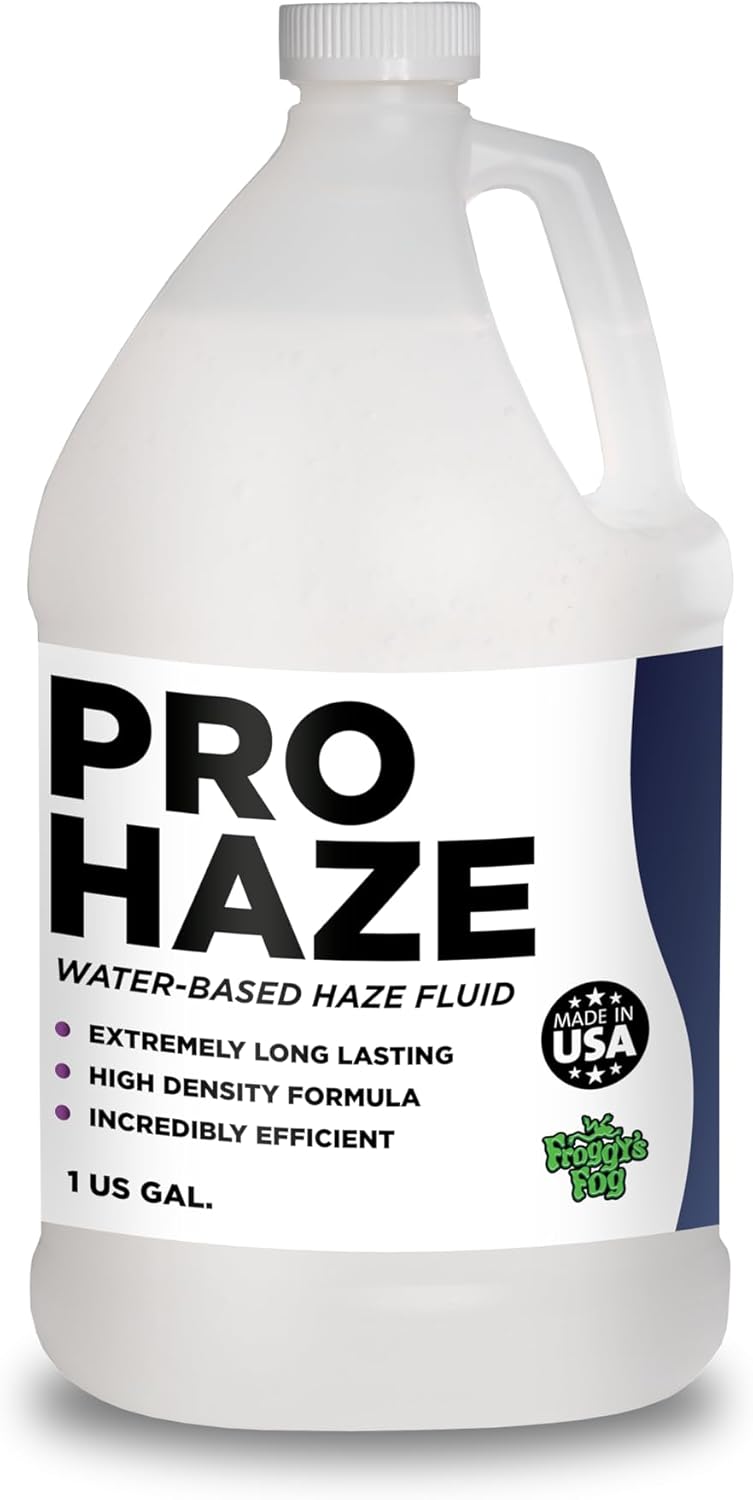
Froggy’s Fog Pro Haze fluid, used in combination with machines like the Antari Hurricane Haze 4D (a dedicated professional haze unit), represents the use case this category was built for. The Froggy’s Pro Haze technical spec sheet describes a water-based formulation producing residue-free, consistent fine-particle output. Operators in long-run reviews consistently report smooth, non-variable output across extended sets — exactly what you need if you’re running a three-hour nightclub event or a touring production where beam consistency from the first song to the last matters. The phrase “residue-free” keeps appearing in reviews, and it connects directly to a real operational concern we’ll address in a moment: floor safety.
Critically, Froggy’s documentation is explicit that their Pro Haze fluid is designed for haze-specific machines. Do not run it through a standard fog machine and expect the same result. The delivery mechanism is different, the heating profile is different, and the output will be wrong.
Fast-Dissipating Fog: The Underrated Specialist
QuikBlast’s product application notes include a use case that stops most buyers cold on first read: a fire department running a safety training facility. The training team uses QuikBlast’s fast-clearing fog because the output is thick enough to simulate genuine low-visibility conditions for trainees but clears fast enough between runs to keep the drill cycle moving safely. That’s not a niche edge case — it’s a signal about what fast-dissipating fog is actually good for.
For event production, fast-dissipating fog has a direct parallel: entrance effects, burst moments, scene transitions. If you need a dramatic cloud for a performer’s entrance and then you need the stage clear again in 90 seconds, fast-dissipating fluid is the right call. If you need continuous atmospheric fill, it’s the wrong call. The dissipation rate isn’t a quality metric — it’s a feature dial, and you need to know which position you want it set to before you buy.
Floor Safety and the Residue Question
This comes up in nearly every intermediate-level forum discussion about fog at dance events, and it’s worth addressing directly because the stakes are real.
ADJ Products’ VF1300 documentation and owner review aggregations tell a notably consistent story: after a full year of professional DJ bookings, operators report no slippery dance floors and no machine downtime requiring maintenance. The VF1300 is a water-based fog system, and the “no residue” outcome is an intrinsic property of water-based fluid rather than glycol-heavy formulations. Glycol-dominant fog fluids — particularly older or cheaper formulations — can leave a light film on hard floors that becomes genuinely hazardous once foot traffic spreads it. If you’re booking nightclubs, school gymnasiums, wedding halls, or any space with a hard dance floor and liability exposure, this is not a minor spec-sheet footnote. It is a contract risk.
The decision rule here is clean: water-based fog and haze fluids for any event where public foot traffic crosses the output zone; glycol-heavy fluids only in controlled theatrical or production environments where the floor surface is managed.
Which Effect Actually Works with Your Rig?
Here’s the decision framework we’d apply to the most common intermediate buyer scenarios.
If you’re running moving-head fixtures and want to see beam sweeps: You need a haze machine with haze-specific fluid. Dense fog will scatter the beams rather than rendering them as clean shafts. The Antari Hurricane Haze 4D with Froggy’s Pro Haze fluid is the combination operators consistently point to in this category.
If you’re running a laser grid or laser animation system: Haze is still the correct answer for continuous beam visibility, but laser-safe certification of your fluid matters — check manufacturer documentation explicitly. Some fluid formulations leave particulate residue on optical surfaces over time. Haze fluid’s finer particle suspension is less problematic here than dense fog.
If you’re producing a theatrical entrance or scene-change effect: Dense fog, potentially fast-dissipating depending on your scene reset time. Chauvet High-Density fluid for long hang, QuikBlast-style fast-clear fluid if you need the stage clean again quickly.
If your venue has a hard dance floor and public audience: Water-based fluid, full stop. ADJ VF1300 owner reports make the safety-maintenance case over a full year of working bookings — that’s the kind of real-world validation that matters more than a single-event test.
If your client is asking for “smoke” to fill the room visually: They almost certainly want fog, not haze. Haze reads as invisible to the naked eye in normal conditions. Set expectations before the event, not after.
Frequently Asked Questions
What is the difference between a haze machine and a fog machine? A fog machine produces thick, visible bursts of vapor that fill a space with a cloud effect. A haze machine produces an extremely fine, nearly invisible particle suspension designed specifically to make light beams visible. Same basic technology — heated fluid, expelled vapor — but tuned for completely different outputs and use cases.
Can I use regular fog fluid in a haze machine? No, and manufacturers are consistent on this point. Haze machines use different heating profiles and nozzle configurations than fog machines, and running standard fog fluid through a haze unit will produce wrong output, potentially damage the machine, and void most manufacturer warranties. Froggy’s Fog documentation explicitly designates their Pro Haze fluid as haze-machine specific.
Which type of effect works better with laser lighting rigs? Haze, clearly. Dense fog scatters laser light and creates a wall effect rather than clean beam geometry. Fine haze particles render laser beams as precise, three-dimensional shafts without obscuring the room or blocking visibility.
Why does my fog dissipate so quickly and what fluid should I switch to? Fast dissipation is a function of particle size, fluid formulation, and room air movement — not machine power. If you need longer hang time, switch to a higher-density, longer-hang fluid like Chauvet High-Density. If fast dissipation is actually serving your use case (entrance bursts, fast-reset moments), lean into it with a fast-clear formulation like QuikBlast rather than fighting it.
Is fast-dissipating fog ever the better choice? Yes — specifically for burst effects that need quick scene resets, and for controlled training or simulation environments (the fire department use case documented in QuikBlast’s application notes is a real and instructive example). Fast-dissipating fog is also lower-risk in venues with sensitive smoke detectors, since it clears before alarm thresholds are reached.
Does fog fluid leave a slippery residue on floors at events? It can, depending on formulation. Glycol-heavy fog fluids are more likely to leave floor residue than water-based formulations. ADJ VF1300 owner reports across a full year of professional DJ events consistently describe no slippery floor incidents — an outcome tied directly to the machine’s water-based fluid system. For any public event on hard flooring, water-based fluid is the responsible default.
The Bottom Line
The haze-vs-fog decision isn’t a quality ranking — it’s a use-case alignment problem. Fog is the right answer for visible atmospheric effects, dramatic bursts, and scene transitions. Haze is the right answer for beam visibility, laser enhancement, and continuous atmospheric fill. The fluid you choose within each category determines hang time, residue risk, and long-term machine health. If you’re running lights or lasers and you’ve been relying on a standard fog machine, the upgrade to a dedicated haze unit with haze-specific fluid is one of the highest-ROI equipment decisions in this tier. If you’re running public events on hard floors, water-based fluid isn’t optional — it’s your liability backstop.
Get the use case right first. The machine and fluid choices follow directly from there.