If you’ve ever watched a horror movie where fog rolls across the floor and wondered how they pull that off, the short answer is a fog machine — a device that heats a water-and-glycol fluid mixture until it flash-vaporizes into a dense, opaque cloud. The higher the wattage (a measure of electrical power, like the rating on a light bulb, except here it’s heating a metal coil), the faster the machine can produce that fog and the larger the space it can realistically fill. At the entry level, a 400–700W machine might be fine for a backyard campfire scare. But if you’re building a professional escape room, running weekly nightclub nights, or producing a haunted attraction with real throughput demands, you’re shopping in a different tier entirely — 1200W and above.
This article is for buyers who already know the basic vocabulary but are deciding which high-wattage machine to commit to. We’ve read every credible owner review, specification sheet, and long-run operator report we could find, and we’re going to name the tradeoffs directly. Sources referenced throughout include the Froggy’s Fog Titan 1200 product documentation and aggregated owner reviews, the Chauvet DJ Hurricane 1200 and Hurricane 1600 official specification sheets, the ADJ Products VF1300 specification sheet and owner Q&A documentation, and the Antari Lighting and Effects Z-3000 technical documentation. Here’s what we found.
Why Wattage Is Only Half the Story
Wattage tells you how fast the heating element can bring fluid to vaporization temperature, but it doesn’t tell you the whole performance picture. Two numbers matter just as much:
Output volume, often rated in cubic feet per minute (CFM — literally how many cubic feet of fog the machine can push out each minute). A machine with higher CFM will fill a room faster, even if its wattage is comparable to a competitor’s.
Heat-up and reheat time — how long you wait after turning the machine on before it’s ready to fire, and how quickly it can recover for a second burst. For escape rooms running back-to-back groups, a 60-second reheat cycle is operationally very different from a 5-minute wait.
Here’s a quick overview of where each machine lands across those dimensions:
| Machine | Wattage | Approx. CFM | Heat-Up Time | Approx. Price (2026) |
|---|---|---|---|---|
| Froggy’s Fog Titan 1200 | 1200W | ~3,500 CFM | ~8 min | $180–$220 |
| Chauvet DJ Hurricane 1200 | 1200W | ~3,000 CFM | ~8 min | $160–$200 |
| Chauvet DJ Hurricane 1600 | 1600W | ~4,000 CFM | ~7 min | $240–$290 |
| ADJ Products VF1300 | 1300W | ~3,000 CFM | ~9 min | $200–$240 |
| Antari Z-3000 class (3000W) | 3000W | ~10,000+ CFM | ~12–15 min | $500–$700+ |
Prices reflect aggregated retail listings as of May 2026. CFM figures are manufacturer-rated per each brand’s published specification sheets.
The pattern that emerges across owner reviews: CFM often predicts real-world fill speed better than wattage alone. That’s a fluid-path and nozzle engineering story as much as it is a raw-power story.
Machine-by-Machine Breakdown
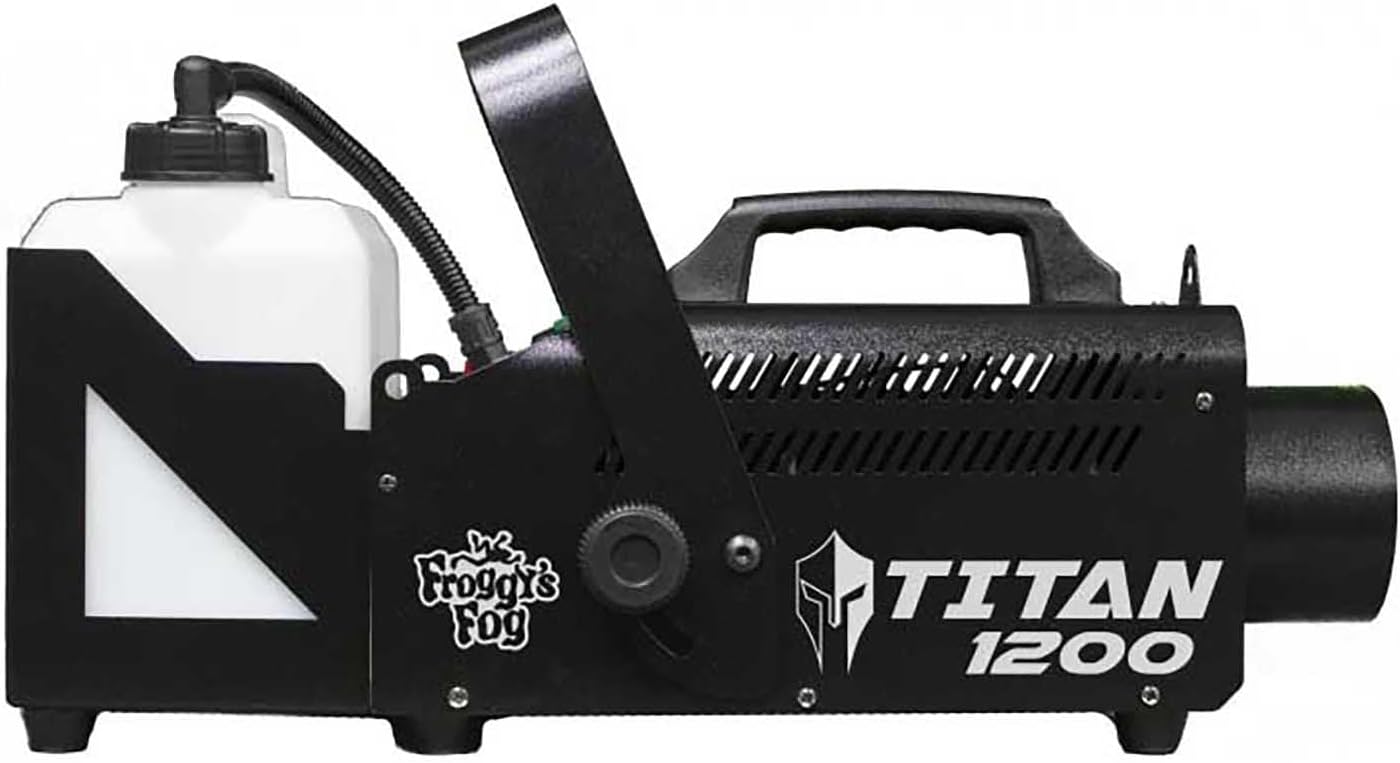
Froggy’s Fog Titan 1200 — The Overachiever at Its Price Point
According to aggregated owner reviews compiled on the Froggy’s Fog Titan 1200 product page, the machine consistently surprises buyers who expected to need more power. The most telling pattern in that review data comes from home haunters who had spent years running 400W budget machines with 15-minute reheat cycles that killed the pacing of their haunt. After switching to the Titan 1200, multiple reviewers describe filling an entire living-room-sized space in roughly 10 seconds — the kind of operational transformation that doesn’t show up in spec sheets but defines whether a machine is actually useful in a live production context.
Commercial operator reviews tell a similar story. Nightclub operators in the Froggy’s Fog aggregated review documentation specifically credit the Titan for outperforming higher-rated competitors in sustained use — a result the brand attributes to its fluid-path engineering, which is detailed in the Froggy’s Fog Titan 1200 product documentation.
The tradeoff: Froggy’s Fog is a somewhat specialized brand, meaning parts, service, and fluid availability may require direct-to-manufacturer sourcing rather than walking into a local shop. For buyers running machines year-round, that’s worth factoring into your decision.
Best for: Buyers purchasing their first serious machine for a mid-size venue under roughly 2,000 square feet who want the best output-per-dollar at the 1200W tier.
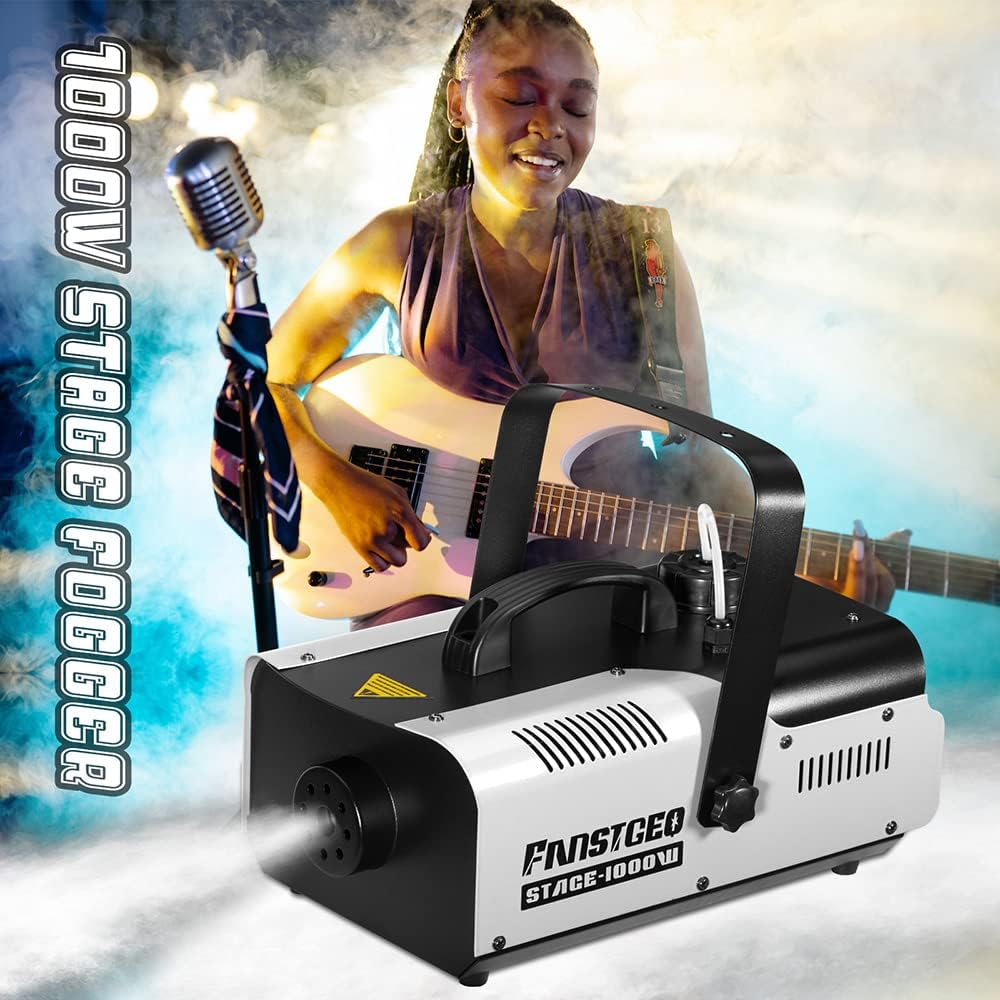
Fog
$75.99
In stock on Amazon
Check price on AmazonChauvet DJ Hurricane 1200 and Hurricane 1600 — Brand Infrastructure vs. Reliability Signals
Chauvet DJ is the dominant brand in this category for a reason: wide retail distribution, strong parts availability, and a recognizable name that makes equipment riders easier with venue staff. The Hurricane line is their primary offering in the serious-use tier, and the Chauvet DJ Hurricane 1200 and Hurricane 1600 specification sheets both reflect well-documented output ratings that have made these machines staples of the production industry.
Hurricane 1200: According to the Chauvet DJ Hurricane 1200 specification sheet, the machine is rated at approximately 3,000 CFM with an 8-minute heat-up time — competitive at the 1200W tier. The reliability signal on this machine in aggregated owner reviews, however, is worth noting directly. Multiple reviewers document unit failures under sustained use, with at least one reporting a replacement unit that failed after a single hour of operation following its first failure. That pattern is not a reason to automatically walk away, but it is a reason to purchase from a retailer with a frictionless return policy and to have a backup plan if you’re opening a haunt in October.
Hurricane 1600: The Hurricane 1600 has the most polarized review data of any machine in this tier, and the polarity is instructive. Per the Chauvet DJ Hurricane 1600 specification sheet, it is rated at approximately 4,000 CFM at 1600W — a meaningful step up in both output and recovery speed. One experienced haunted attraction operator describes it as best-in-class with no qualifications. Another reviewer received a dead-on-arrival unit but, after replacement and pairing with premium fog fluid, became a convert. That second data point is genuinely useful: it suggests fluid quality meaningfully affects the perceived performance of this machine. The Hurricane 1600, more than the other units here, seems to reward pairing with high-quality water-and-glycol fluid formulated for high-output machines.
The tradeoff on both units: Chauvet’s brand infrastructure is real value, particularly for commercial venues with equipment rider requirements. But the reliability concerns documented in owner reviews warrant building in a contingency, especially for the 1200W model.
Best for: The Hurricane 1200 suits buyers who need Chauvet on a venue or corporate equipment rider and can build in a backup unit for the first season. The Hurricane 1600 suits escape room and haunted attraction operators willing to commit to premium fluid for consistent output across multiple nightly resets.
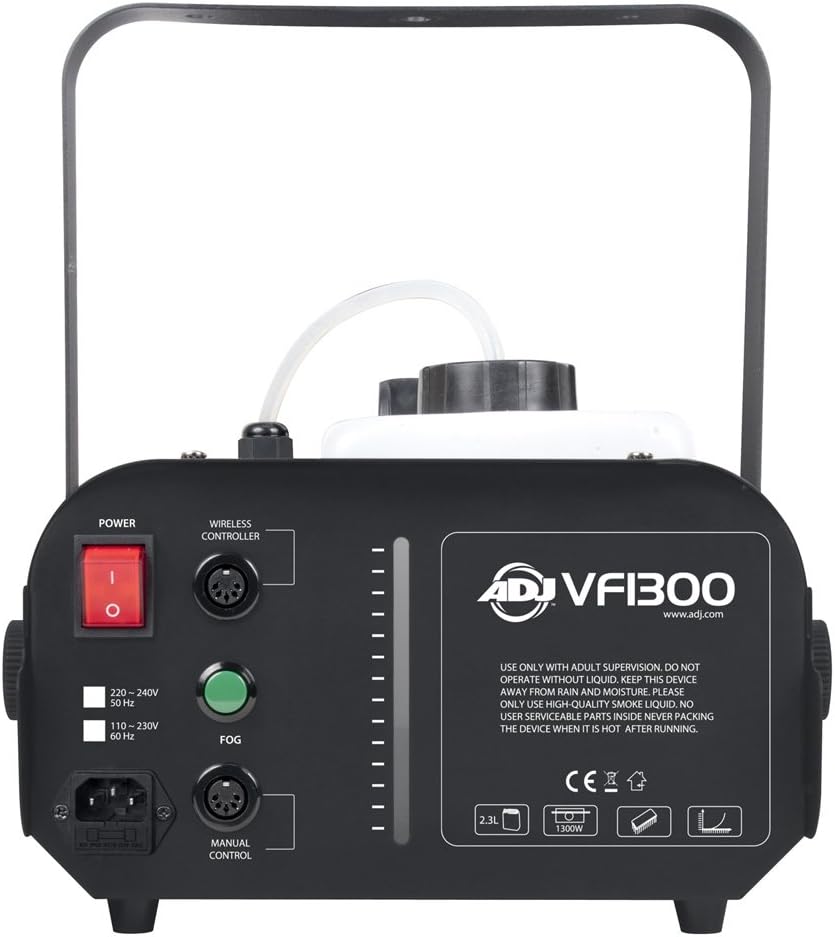
ADJ
$169.99
In stock on Amazon
Check price on AmazonADJ Products VF1300 — The Durability Dark Horse
The ADJ Products VF1300 doesn’t generate the volume of review data that Chauvet does, but the reviews it does have are unusually credible in their depth. According to the ADJ Products VF1300 specification sheet and owner Q&A documentation, the machine is rated at approximately 1,300W and 3,000 CFM — placing it between the Chauvet Hurricane 1200 and Hurricane 1600 on output. What distinguishes the VF1300 in owner reporting isn’t its output peak but its sustained-use reliability.
One professional DJ who documented their experience in an extended owner Q&A confirmed the machine was still performing without issue after a full year of consistent gigging — a data point that’s genuinely rare in this category, where most reviews are written within the first two weeks of ownership. Per the ADJ Products VF1300 owner Q&A documentation, this aligns with ADJ’s stated engineering priorities for the unit, which emphasize thermal management and heating block longevity.
At 1,300W and approximately 3,000 CFM, the VF1300 is not the highest-output machine in this bracket. But if your use case involves frequent gigging or regular commercial deployment where machine longevity matters as much as raw output, the long-run reliability signal documented in ADJ’s owner Q&A is worth weighting heavily.
The tradeoff: Less brand recognition than Chauvet, and the review corpus is thinner. You’re relying on fewer but higher-quality data points drawn from longer ownership windows.
Best for: Mobile DJs and event producers who run fog consistently across dozens of gigs per year and cannot afford mid-season failures.
ADJ
$169.99
In stock on Amazon
Check price on AmazonAntari Z-3000 Class — When the Room Demands It
The 3000W tier is a different category of purchase: higher cost, higher output, higher operational complexity. According to the Antari Lighting and Effects Z-3000 technical documentation, the machine is rated at over 10,000 CFM, requires a dedicated 20-amp circuit, and carries a substantially higher fluid consumption rate than any 1200–1600W unit.
The clearest real-world benchmark in available operator documentation comes from professional AV technicians describing use of 3000W commercial units in large-format venue contexts. The operational signature at this tier is consistent across that documentation: fill times for rooms in the range of 20,000–25,000 cubic feet that would require continuous machine operation at the 1600W tier can instead be achieved in two to three 10-second timed bursts. For a nightclub main room, a large-format haunted attraction, or a theatrical production with a large stage, that operational difference changes what kinds of production cues are achievable.
The tradeoff: Per the Antari Z-3000 technical documentation, the machine requires a dedicated 20-amp circuit — standard residential 15-amp circuits will not support it. Heat-up times are longer than lower-wattage units. Fluid consumption is substantially higher; budget for premium fluid accordingly.
Best for: Venues exceeding roughly 5,000 square feet, productions requiring near-instant saturation of a large space on a precise timing cue, or large-format haunted attractions where fill speed is a core element of the guest experience.
Froggy's
$299.99
In stock on Amazon
Check price on AmazonFrequently Asked Questions
What does CFM mean on a fog machine and why does it matter more than wattage? CFM stands for cubic feet per minute — it measures how much fog volume the machine pushes into the room per minute. Wattage tells you how powerful the heating element is; CFM tells you how useful that power is in practice. A machine with high wattage but a poorly designed fluid path and nozzle can underperform a lower-wattage machine with better CFM engineering. When comparing machines, CFM is the more reliable predictor of real-world fill speed, as noted consistently across manufacturer specification sheets from Froggy’s Fog, Chauvet DJ, ADJ Products, and Antari.
Do high-output fog machines require special fluid, or will any water-based fluid work? Technically, any water-and-glycol-based fog fluid will work in any machine rated for that fluid type. Practically, fluid quality matters significantly at the higher output tier. Owner review data compiled in the Chauvet DJ Hurricane 1600 documentation context makes this explicit: operators who switched to premium-grade fluid reported noticeably better output and density from the same machine. Higher-quality fluids also tend to leave less residue in the heating block, reducing clogging frequency over time.
How do I prevent my fog machine from clogging between uses? The most consistently recommended practice across manufacturer guidance and operator documentation: run clean water through the machine at the end of every use session to flush residue from the heating block. Store the machine with the tank empty or nearly empty. Avoid using fluid with additives not listed in the machine’s approved fluid documentation. The Chauvet DJ Hurricane 1200 specification sheet and Chauvet’s published maintenance guidance both reference regular flushing as a key longevity factor.
What size venue does a 1200W fog machine actually cover effectively? Based on aggregated owner reports and manufacturer output ratings from the Froggy’s Fog Titan 1200 product documentation and Chauvet DJ Hurricane 1200 specification sheet, a 1200W machine with CFM ratings in the 3,000–3,500 range covers rooms up to approximately 1,500–2,500 square feet effectively — depending on ceiling height, ventilation, and how quickly you need saturation. Rooms with high ceilings (above 12 feet) or active HVAC systems will consume output faster.
When does it make sense to step up to a 3000W professional fog machine? When your venue or production space exceeds roughly 5,000 square feet, when ceiling height is above 14–16 feet, or when your production cue requires near-instant saturation of a large volume on a precise timing beat. Per the Antari Lighting and Effects Z-3000 technical documentation, the operational benchmark at this tier — rapid fill of very large volumes in short timed bursts — is simply not achievable at the 1200–1600W tier regardless of how well those machines are optimized. If your room meaningfully exceeds 2,500 square feet and fill speed matters, the 3000W tier pays for itself in effect quality and time saved per production cycle.