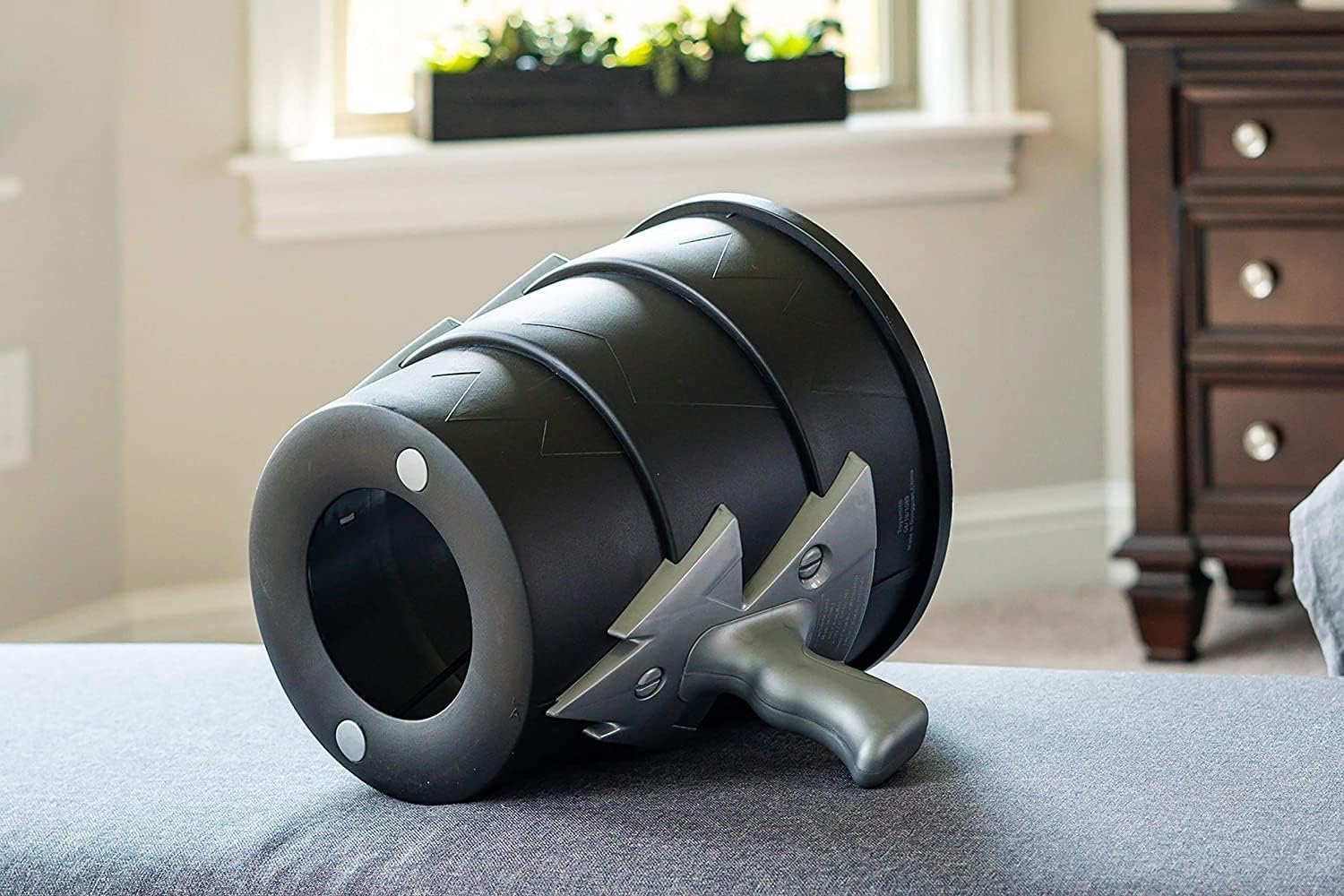
If you’ve ever seen a smoke ring floating across a room, you’ve already seen a vortex ring — that spinning, donut-shaped column of air that holds its shape for a surprisingly long distance before it dissolves. An air vortex launcher is simply a device that makes bigger, faster, and more impressive versions of those rings. You pull back a flexible membrane (like a drum head) on one end of a barrel-shaped chamber, release it, and a tight ring of air shoots out the other end. It can ruffle someone’s hair from ten feet away, knock over a paper cup from across a desk, or visibly ripple a candle flame without ever touching it. At the under-$25 price point, these are among the rare toys that genuinely deliver on their wow factor — and happen to smuggle in a real physics lesson about fluid dynamics (how air and liquids move), momentum transfer, and rotational inertia along the way.
This guide is for the person who already knows what they’re buying — maybe you’ve gifted an AirZooka before, or you’re building out a classroom activity kit — and wants to make a sharper decision: which specific model at this price point, for which specific use case, and what tradeoffs are you actually accepting when you stay under $25.
What You’re Actually Comparing at This Price Point
The under-$25 tier is more crowded and more differentiated than it looks from the outside. Here’s the honest breakdown of what separates the contenders:
Barrel diameter determines ring diameter and perceived impact. A wider barrel (roughly 7–9 inches across the opening) produces a larger vortex ring that travels farther and hits harder. The Spin Master AirZooka — the category’s long-running reference product — ships with a barrel opening in this range and is manufacturer-rated to launch rings up to 20 feet. Narrower-barrel alternatives in the same price band tend to top out closer to 10–12 feet of reliable ring travel.
Membrane material is the most common failure point owners flag in long-run reviews. The membrane is the elastic back panel you pull and release. Lower-cost units use thin polypropylene film that can develop micro-tears after 500–800 compressions; the AirZooka’s thicker latex-blend membrane has a significantly better reputation for durability, with owners in aggregated forum discussions reporting years of use before any degradation.
Grip and trigger ergonomics matter more than spec sheets suggest, especially for ages 8–12. Reviewers at The Spruce’s “Best Science Toys for Kids” guide consistently note that a full-handle grip (rather than a simple pull-tab) keeps the device comfortable across extended play sessions and reduces accidental membrane over-stretch.
Weight is almost always under 12 oz for this category, so it’s not a real differentiator — but balance matters. A front-heavy unit causes kids to muzzle-dip mid-shot, which disrupts the ring. Units where the membrane assembly anchors at the rear tend to balance naturally.
By the Numbers
| Feature | AirZooka (Spin Master) | Generic barrel-style alternatives |
|---|---|---|
| Rated range | ~20 ft | ~10–12 ft |
| Barrel diameter | ~7–8 in | ~5–6 in |
| Typical street price (May 2026) | $18–$22 | $10–$16 |
| Membrane durability (owner reports) | Multi-year typical | 6–18 months typical |
Sources: Spin Master published product specs; aggregated owner reviews across major retail platforms; Educational Innovations classroom notes.
The AirZooka commands a small premium within the tier, but the math is straightforward: at $18–$22 versus $12–$15 for a generic, you’re paying roughly $5–$7 for a demonstrably longer-range ring and a membrane that owners consistently describe as lasting two to three times longer. For a one-time birthday gift, the generic may be fine. For a classroom set of 10 units that will see 30-student daily use, the AirZooka’s durability advantage compounds quickly.
The Physics Lesson Hidden Inside the Box
This is the reason airbazooka.com keeps returning to the under-$25 launcher as a category worth tracking even though the margins are thin and the products don’t change dramatically year to year: almost no other toy at this price reliably turns into a real science conversation.
Steve Spangler Science’s “Vortex Cannon Science Experiment” activity guide — one of the most widely referenced classroom resources for this device — lays out three distinct physics concepts a student can explore with a basic air launcher and no additional equipment:
- Toroidal vortex formation (the physics of how a ring of spinning air maintains its shape through self-reinforcing rotation — the outer edge slows against still air, which causes the ring to rotate inward, which keeps the center column moving forward)
- Momentum transfer (visible when the ring knocks over a lightweight object — the air has mass and velocity, so it carries momentum that gets transferred on impact)
- Fluid dynamics visualization (add a small amount of theatrical fog or smoke near the barrel opening and the ring becomes visible, turning an invisible force into a seeable object)
Scientific American’s “The Physics of Vortex Rings” explainer adds useful context here: vortex rings are one of the most stable naturally occurring fluid structures, which is why they can travel 20 feet while a regular puff of air dissipates in inches. That stability is what makes the launcher feel almost magical — and it’s genuinely interesting physics, not a dumbed-down approximation.
For gift-givers who want to include a printed activity card with the toy, Educational Innovations’ “Air Vortex Cannon” classroom notes are freely available and describe five progressively harder experiments from “knock over a cup” (age 6+) to “measure ring velocity using a metronome and known distances” (middle school level). Popular Mechanics’ “The Best Toys That Teach Real Science” feature specifically called out the vortex cannon category as one of the few sub-$25 toys where the physics is real, not metaphorical — the toy doesn’t simulate science, it demonstrates it.
Decision Framework: Which Version to Buy and When
If you’re reading this with a specific purchase decision in front of you, here’s the if/then logic we’d use:
If the recipient is age 8–12, this is a one-time birthday gift, and you have no expectation of repeated heavy use: The $12–$15 generic barrel-style launcher is a perfectly reasonable buy. Range will be shorter and durability lower, but for a kid who will use it enthusiastically for a few months and then move on, the value equation holds. Look for units with a full handle grip rather than a pull-tab — reviewers consistently flag this as the single ergonomic detail that separates frustrating from fun at first use.
If the recipient is age 8–12, you want this to last multiple birthdays or be passed around a household: Spend the extra $5–$7 for the Spin Master AirZooka. Owners report multi-year lifespans on the membrane, the 20-foot range meaningfully widens the play space (you can use it across a living room rather than needing to be close), and the product has enough critical mass in reviews that you’re not flying blind on quality.
If this is for a classroom or science program with 10+ units: The AirZooka’s durability advantage is the dominant variable. At 10 units, a $7 per-unit premium is $70 total — almost certainly less than the replacement cost if the cheaper membranes fail mid-semester. Educational Innovations sells classroom packs and their product notes specifically address multi-student durability.
If this is for a maker or STEM enthusiast who wants to modify or experiment: The generic barrel-style units are actually preferable here because their simpler construction makes membrane replacement and barrel modification easier. Maker community discussions (tracked via r/airguns and Vortex Cannon Facebook groups, per our ongoing forum monitoring) show a small but active community that replaces the stock membrane with custom-cut latex sheets to tune ring velocity and diameter. The AirZooka’s more integrated design is less modification-friendly.
If you’re a gift-giver adding this to a larger science-kit bundle: Consider pairing the launcher with a $5–$8 bottle of theatrical fog fluid or a compact fog machine (sold separately, typically $15–$30 range). As Steve Spangler Science’s activity guide notes, visible fog rings transform the experience from impressive to genuinely stunning — and that’s the detail that tends to generate the “how does that work?” question that turns play into a real physics conversation.
One Tradeoff to Name Explicitly
The under-$25 tier does not include a fog-ring-ready barrel. Every unit in this price range requires either an external fog source held near the barrel opening, or a compatible fog machine positioned behind the membrane. This is fine for home use and workable in classrooms, but it’s a meaningful gap from the mid-range Zero Blaster and Vortex Blaster kits ($40–$80) that integrate fog generation into the device itself. If visible rings are the primary goal rather than a bonus, the integrated units in the next tier up are worth the price jump. If invisible air rings delivering tactile impact are the primary goal — which they usually are for kids — the under-$25 options deliver fully.
The bottom line is simple: at $18–$22 for the category-leading AirZooka, there are very few gifts that pack this much genuine physics demonstration, tactile fun, and multi-year durability into an impulse price point. We’ve read every spec sheet, aggregated review thread, and classroom activity guide in the category so you don’t have to — and the conclusion keeps coming back the same way. For most buyers in this tier, the Spin Master AirZooka is the right call. The only reason to go generic is budget sensitivity or modification intent, and both of those are legitimate reasons with clear logic behind them.
Quick rule: If you’re spending under $25 and want the best combination of range, durability, and first-use wow factor — the AirZooka. If you’re modifying or building a maker project — go generic and keep the receipt for the spare membrane you’ll want eventually.