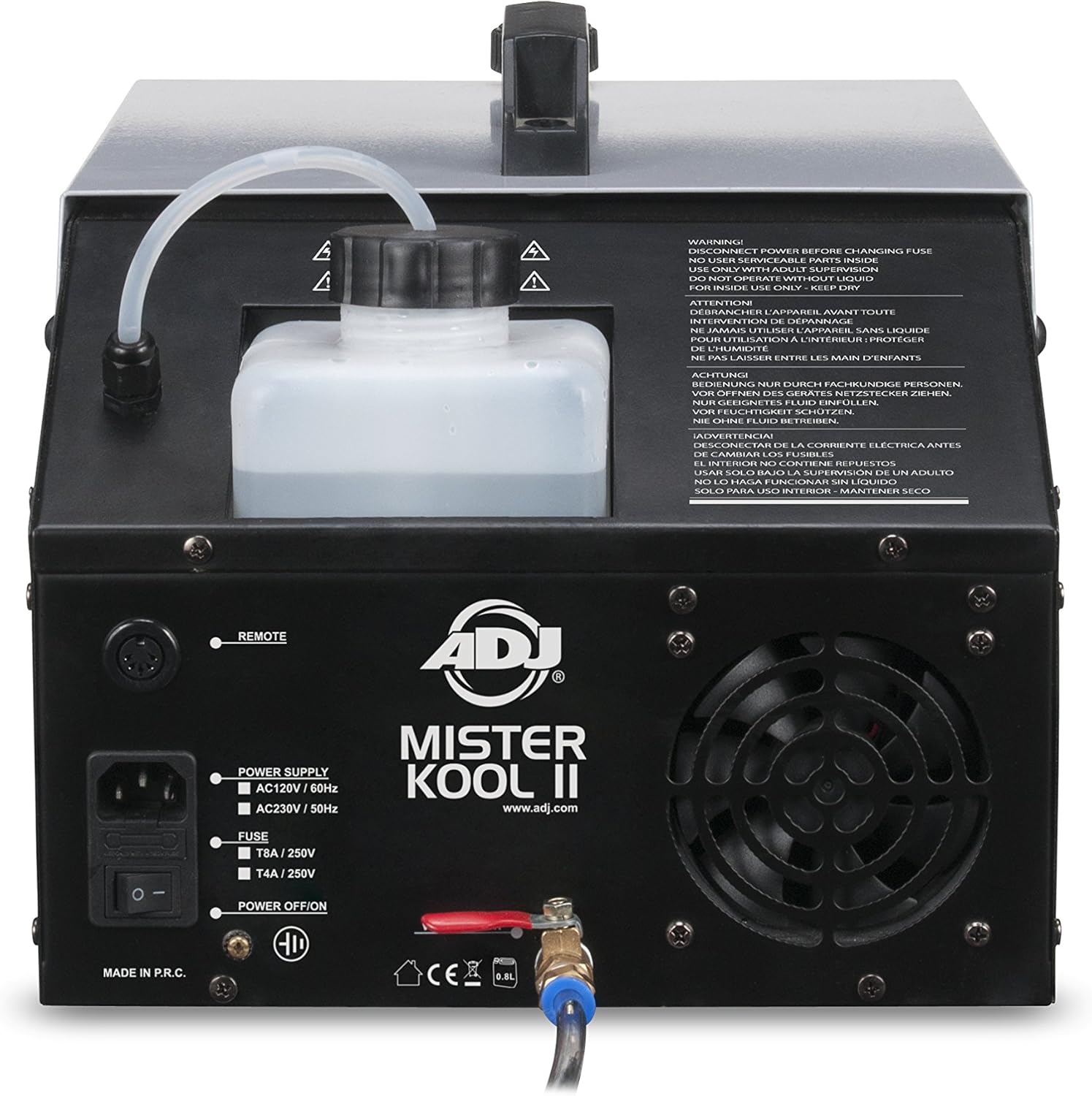
If you’ve ever watched a smoke ring drift lazily across a room, you’ve already seen a vortex ring in action — a donut-shaped loop of moving air that holds its shape because of the way spinning fluid conserves momentum. An air bazooka (or vortex cannon) fires those same rings, just faster and bigger. Now imagine those rings staying low, rolling across the floor in a dense white ribbon instead of rising toward the ceiling. That’s what a ground-effect fog machine makes possible. Unlike a standard fog machine — which pumps warm, buoyant vapor upward — a ground-effect machine chills its output, making the fog denser than the surrounding air so it sinks and spreads at floor level. When you pair that chilled, low-lying fog with a vortex cannon, the rings become visible in a way that standard room-temperature fog never quite achieves. This article is for the buyer who already understands what a vortex cannon does and is now trying to spec the fog layer that will make it perform.
How Ground-Effect Fog Actually Works (and Why It Matters for Vortex Rings)
Standard theatrical fog machines heat a water-and-glycol fluid to produce vapor, which exits the nozzle hot and rises. That’s fine for atmospheric haze, but it’s the enemy of a clean vortex ring demo. A hot, rising fog layer defeats the physics: your ring punches through and the visual collapses within a meter.
Ground-effect machines solve this with one of two approaches:
Dry-ice chilling. The machine pushes warm fog over a reservoir of dry ice (solid CO₂, which sublimes at −78 °C). The fog cools rapidly, becomes denser than ambient air, and drops to the floor. The CO₂ itself also contributes a faint secondary haze. This method produces the densest, most dramatic low-lying layer — reviewers and event operators consistently describe it as the “real” ground fog look — but it requires ongoing dry-ice resupply, which adds cost and logistics.
Liquid CO₂ or refrigerant-chilled systems. These machines use an internal refrigeration loop to chill fog output without external dry ice. Antari’s Z-350 and ADJ’s Glacier line are the most-cited examples in owner forums and technical documentation. They’re more convenient for repeated use but produce a thinner, less billowy layer than dry-ice units at the same output setting.
Why does this matter for vortex ring visibility? The Physics Classroom’s resource on fluid dynamics and vortex ring formation explains the key principle: a vortex ring is a region of rotating fluid moving through a medium of different density or velocity. The sharper the contrast between the ring’s carried fluid and the surrounding air, the longer the ring holds coherent form. Chilled, dense fog inside a vortex ring creates exactly that contrast. Scientific American’s feature on smoke ring physics notes that rings in denser-than-ambient media can maintain structure for two to three times the distance compared to rings in uniform ambient air — which is the practical reason a good ground-fog layer turns a three-meter vortex cannon shot into a five- or six-meter one that the audience actually sees land.
Fluid Types: What You Can Use and What the Spec Sheets Actually Say
This is where buyers make expensive mistakes. Not all fog fluids are interchangeable, and using the wrong fluid in a chilled-output machine has consequences ranging from poor output density to voided warranties and clogged heat exchangers.
Standard water-glycol fog fluid is the default for most theatrical machines. It’s cheap, widely available, and safe for indoor use when ventilation is adequate. But in a low-fog application, the glycol concentration matters more than it does in a standard upward-discharge machine — higher-glycol formulas produce a thicker, longer-lasting layer at lower output temperatures. Chauvet DJ’s Hurricane Haze product documentation explicitly recommends their “Thick” fluid formula for low-fog applications, warning that thin/haze-grade fluids can fail to maintain density when chilled.
Glycerin-based fluids run cleaner (lower residue) and are the preferred choice for spaces where floor surfaces matter — hardwood performance stages, museum floors, escape room sets with electronics at floor level. The tradeoff is slightly lower visual density per liter. Operators in long-run reviews on event-production forums note that glycerin fluids require slightly higher heater-block temperatures to atomize fully, which means some budget low-fog machines underheat them and produce wet output (droplets rather than vapor).
Water-only or “water fog” fluids are marketed for children’s events and classroom use on the premise of eliminating glycol entirely. Educational Innovations’ product notes on their fog ring demonstration kits flag these fluids as appropriate for classroom use but note reduced fog density and shorter hang-time compared to glycol blends. For a classroom physics demo, that’s an acceptable tradeoff; for a professional event or escape room where hang-time is part of the effect, it’s generally not.
Fluid you should never use in a ground-effect machine: oil-based fluids (designed for haze machines, not fog machines) and any fluid not rated for your specific unit’s heater-block temperature range. ADJ’s Glacier spec sheet is explicit that oil-based fluids will clog the chilling chamber permanently.
By the Numbers
| Fluid Type | Approx. Cost per Liter (May 2026) | Hang-Time (still air) | Floor Residue Risk |
|---|---|---|---|
| Standard water-glycol (thick) | $8–$14 | 4–8 min | Low–moderate |
| Glycerin-based | $12–$20 | 3–6 min | Low |
| Water-only “classroom” blend | $6–$10 | 1–3 min | Minimal |
| Haze/oil-based (do not use) | $10–$18 | N/A | High + equipment damage |
Matching Machine Class to Your Use Case
Here’s the tradeoff matrix we’ve assembled from manufacturer specs, operator documentation, and aggregated owner accounts across the ADJ, Antari, and Chauvet product lines.
Entry-level dry-ice machines ($150–$350): These units provide a basin you fill with dry ice and a fan or heating element that pushes fog across it. Output density is high, but control is coarse — you can’t precisely throttle fog volume the way you can with a refrigerant-chilled unit. For a science fair, a classroom demo, or a one-off escape room opening night, they’re excellent value. The recurring cost is dry ice: expect to budget $1–$3 per pound depending on your region and supplier, and budget for 5–15 pounds per event hour depending on the basin size and ambient temperature.
Mid-range refrigerant-chilled machines ($350–$700): The Antari Z-350 and comparable ADJ Glacier units sit here. Spec sheets rate the Z-350 at approximately 1,500W heater output with an integrated chilling loop, producing a self-described “continuous low fog output” without dry-ice resupply. Owners consistently report these as the workhorse choice for escape rooms and recurring event setups — you load fluid, plug it in, and run. The tradeoff versus dry ice: the fog layer is thinner and less billowy, which reduces the visual drama of vortex ring shots at distances beyond four meters.
Commercial-grade and custom systems ($700–$2,500+): High-volume event producers and science center installations described in procurement discussions typically specify units in this range — often dual-output machines with independent chilling and fog-generation circuits, DMX control for real-time density adjustment, and fluid capacities of 5+ liters. At this tier, matching the vortex cannon’s output rate to the fog machine’s replenishment rate becomes the central spec question. If your vortex cannon cycle time is faster than the fog layer recovers, you’ll get diminishing visual returns on successive shots.
Practical Setup Variables That Spec Sheets Won’t Tell You
Published specs assume ideal conditions. Here’s what aggregated owner and operator accounts tell us actually matters in a live demo environment:
Ambient temperature and airflow are the dominant variables. A ground-fog layer rated for 6-minute hang-time in still air can collapse in under 90 seconds if HVAC is running or doors are open. Operators in event-production community discussions consistently flag this as the top failure mode in venue settings. Budget for a pre-show HVAC shutoff window, or accept a thinner, faster-cycling fog layer.
Floor surface affects perceived density. Dark or matte floors dramatically increase the visual contrast of a white fog layer. Reflective or polished floors create a mirror effect that some venues love and some find distracting. This matters for vortex ring demos specifically because the ring’s “footprint” as it travels is visible against the fog layer — high contrast floors make the ring trackable for the audience.
Nozzle height for the vortex cannon. The sweet spot reported by science center demonstrators and escape room operators is a nozzle positioned 15–25 cm above the top of the fog layer, firing horizontally. Too low and the cannon disturbs the fog layer on discharge, creating turbulence that obscures the ring. Too high and the ring exits above the fog and loses its visual anchor.
Warm-up time is non-negotiable. ADJ’s Glacier documentation specifies a 10–12 minute warm-up before first output. Antari’s Z-350 manual lists a similar 8–10 minute window. Operators who skip this step consistently report poor initial fog density in the first few minutes of a demo — which is exactly when an audience or classroom group is forming first impressions.
The Decision Rule
Here’s the “if X, then Y” framework based on everything we’ve read across spec documentation, operator notes, and educational-use accounts:
-
If you’re running a classroom or science fair demo (single session, ≤30 min of runtime): A dry-ice entry-level unit plus a water-only or low-glycol classroom fluid is the lowest-cost, lowest-maintenance path. Source dry ice the day of the event. Budget roughly $20–$40 in dry ice per demo session.
-
If you’re running a recurring venue installation (escape room, science center, regular event production): Invest in a refrigerant-chilled mid-range unit like the Antari Z-350 or ADJ Glacier tier. Use a thick glycol or glycerin fluid matched to the manufacturer’s spec. The higher upfront cost eliminates dry-ice logistics and produces consistent, repeatable output.
-
If maximum visual impact at distance (5+ meters) is the primary goal: Dry ice wins on fog density. Accept the logistics cost, use a high-glycol thick fluid, and control HVAC aggressively. No refrigerant-chilled consumer unit currently on the market matches dry-ice density at the same output wattage — this is a physics constraint, not a product quality issue.
-
If you’re speccing for a commercial theatrical or broadcast application: Get a dual-circuit commercial unit with DMX control and spec it against your vortex cannon’s cycle rate. The fog replenishment rate is the binding constraint — a cannon that fires every 3 seconds needs a machine that can restore fog density in under 3 seconds, and most sub-$700 units cannot.
The vortex ring is doing real fluid-dynamics work every time it fires. The fog layer is the instrument that makes that work visible. Match the two correctly, and the physics sells itself.