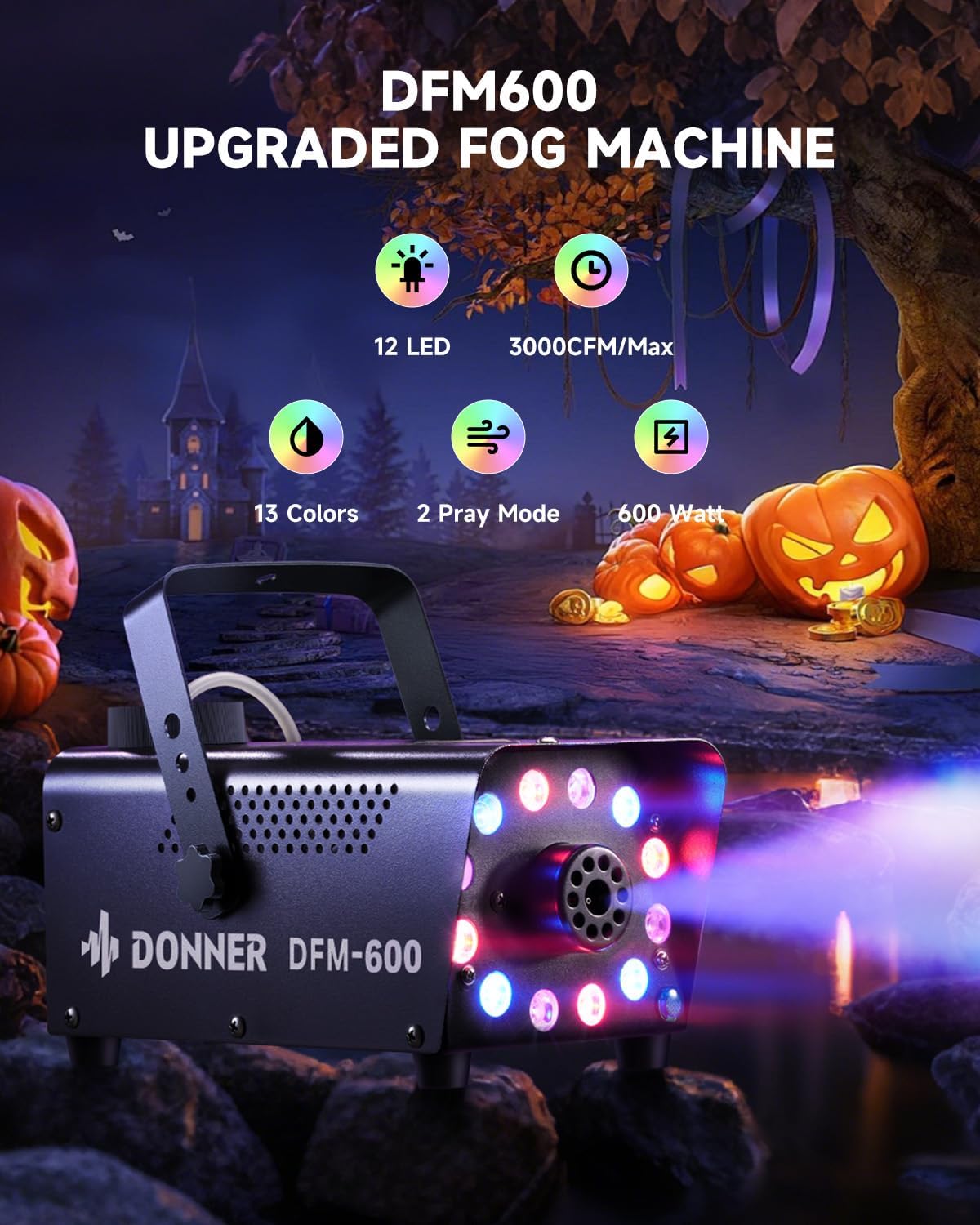
If you’ve ever watched a Halloween fog machine push a slow, rolling cloud across a floor and wondered why it never quite becomes the crisp, floating ring you see at science demonstrations — you’ve already identified the central question this article answers. A vortex ring is a donut-shaped loop of spinning air (or fog-laden air) that holds its shape as it travels. An air bazooka or vortex cannon is the device that launches those rings with enough force and geometry to keep them tight across a room. The challenge in the 500W–1200W fog machine category — the sweet spot for Halloween setups, mid-size parties, and event producers working on modest budgets — is that not every fog machine produces fog that wants to form rings. Output density, fluid chemistry, warm-up time, and duty cycle (how long the machine can run before it needs a rest) all interact in ways that spec sheets understate and owner reviews frequently clarify. Here’s what we found when we mapped those variables across the models that dominate this tier.
Why Wattage Is Only Part of the Story
Wattage tells you how fast a fog machine heats its fluid reservoir — higher wattage generally means faster warm-up and more output volume per burst. Popular Mechanics’ explainer on fog machine mechanics describes the core process clearly: a resistance heater brings a glycol-and-water fluid (the “fog juice”) to vaporization temperature, and the resulting aerosol exits through a nozzle as visible fog. But for vortex ring applications specifically, raw volume is less important than output density — how thick and slow-moving the fog cloud is per cubic foot — and particle size, which determines how long the fog holds cohesion before dispersing.
Scientific American’s coverage of vortex ring physics notes that ring stability depends on the fluid’s momentum-to-viscosity ratio. Translated to practical fog: a thin, wispy output (common in underpowered or low-fluid-quality setups) disperses before the ring can travel more than a few feet. A dense, slow output — often described by owners as “ground-hugging” or “heavy” — gives the vortex cannon or air bazooka enough material to shape and launch a ring that carries across a room. This is why fluid selection is not a footnote; it’s a primary variable. Froggy’s Fog’s Buyer’s Guide explicitly separates fluids into “standard,” “water-based dense,” and “quick-dissipating” categories, and recommends dense-formula fluid for any vortex or low-lying effect application. Running standard fluid through a well-rated machine is one of the most common reasons owners report disappointing ring quality in forum discussions.
The 500W–1200W Segment: A Tradeoff Map
This wattage range splits into three practical tiers, each with a distinct tradeoff profile.
500W–700W: Budget-Accessible, Patience Required
Machines in this range — think Chauvet DJ’s Hurricane 700, which the Chauvet spec sheet rates at 700W with a 3-minute warm-up — are the workhorses of seasonal Halloween retail. The Spruce’s October 2025 Halloween fog machine roundup identifies the Hurricane 700 as a consistent pick for home haunters and small indoor setups, noting that owners frequently cite its compact footprint and reliable output as strengths, while flagging the duty cycle as the principal limitation: roughly 35–40 seconds of continuous output before the heater needs recovery time.
For vortex ring applications, that duty cycle matters more than it does for ambient fog. An air bazooka or vortex cannon needs a sustained fog feed to pre-charge the launch chamber. If the machine cuts out mid-fill, the ring launches thin and collapses early. Owners who pair 700W machines with vortex launchers in aggregated reviews consistently describe the workaround: fill a large plastic bin or diffusion chamber with fog first, then draw from the reservoir rather than the machine’s live output. It works, but it adds setup time and reduces spontaneity — a real tradeoff for live event use.
ADJ Products’ comparison chart places their VF400 (400W, listed for reference) and Entour Faze (700W equivalent, haze-style output) in this tier, noting that haze-style machines — which produce ultra-fine, long-hang-time particles — actually perform worse for vortex rings than standard fog machines, because the particles are too light to hold a ring shape. Worth knowing if you’re comparing spec sheets without that context.
800W–1000W: The Practitioner Sweet Spot
This is where the value-to-performance curve bends most favorably for buyers who plan to use fog as a vortex medium rather than just ambient atmosphere. The Chauvet DJ Hurricane 1000 spec sheet rates the unit at 1000W, 30-second warm-up, and approximately 50 seconds of continuous output before duty-cycle recovery — a meaningful improvement over the 700W class.
By the numbers:
| Machine Class | Warm-Up | Continuous Output | Approx. Street Price (May 2026) |
|---|---|---|---|
| 700W (e.g., Hurricane 700) | ~3 min | ~35–40 sec | $65–$90 |
| 1000W (e.g., Hurricane 1000) | ~30 sec | ~45–55 sec | $110–$145 |
| 1200W (prosumer, ADJ Entour class) | ~20 sec | ~60–75 sec | $160–$220 |
The 1000W class hits a practical threshold: enough continuous output to fill a standard vortex cannon chamber (typically 12–18 inches in diameter, 24–36 inches deep) in a single uninterrupted burst, which is what produces the cleanest ring launches. Owners in long-run reviews — particularly those running escape rooms or recurring Halloween attractions — consistently report that the step from 700W to 1000W is more noticeable in practice than the wattage numbers suggest, because the duty cycle improvement is proportionally larger than the wattage increase.
The fluid pairing recommendation holds firmly in this tier: The Spruce’s roundup specifically notes that Froggy’s Fog dense-formula fluid is among the most frequently cited upgrades in owner reviews for machines in the $100–$150 range, with owners reporting noticeably improved ring cohesion and hang time compared to generic or house-brand fluid.
1200W and Above: Approaching Prosumer Territory
At 1200W, you’re at the upper edge of what most people mean by “party fog machine” and the lower edge of what event producers classify as professional gear. ADJ’s Entour Faze and comparable Antari units in this range shift toward quasi-continuous operation — some are rated for duty cycles of 1:1 (one minute on, one minute off) rather than the shorter burst cycles of lower-wattage consumer units.
For vortex ring quality, 1200W machines offer one significant practical advantage beyond output volume: thermal stability. Heater recovery at this power level is fast enough that back-to-back ring launches — filling the cannon chamber, launching, re-filling — become feasible without a long pause between cycles. Escape room operators and science center educators, who may need to run demonstrations every few minutes for hours at a time, consistently describe this as the deciding factor in their purchase decisions, per aggregated purchasing reviews from institutional buyers.
The tradeoff is noise and heat. Owners consistently note that 1200W units run warmer and louder than 1000W machines — relevant if your fog machine is in the same room as the audience rather than in a side staging area. For enclosed Halloween setups or smaller venues, this can matter.
Fluid Chemistry: The Variable Everyone Underweights
We’d be doing you a disservice if we treated fog fluid as a commodity line item. Froggy’s Fog’s Buyer’s Guide is unusually direct on this point: their dense fog formulas use a higher glycol concentration than standard fluids, which produces larger aerosol particles that hang lower, disperse more slowly, and — critically for vortex ring applications — provide more mass per unit volume for the ring to maintain its rotational momentum.
Scientific American’s vortex ring physics coverage reinforces why this matters: the ring’s ability to hold shape over distance is a function of the density differential between the ring material and the surrounding air. More particle mass = more ring stability = longer visible travel distance. In practical owner reports, switching from generic fluid to dense-formula fluid in a 1000W machine produces results that owners describe as equivalent to stepping up a machine class — for roughly $20–$30 in fluid cost.
The inverse is also documented: running quick-dissipating (“water-based atmospheric”) fluid — designed for long hang time in haze applications — in a fog machine used for vortex rings produces particularly poor results. The particles are too light and too diffuse to hold ring structure. If you see this fluid category marketed as “safer” or “cleaner” for indoor use, know that those properties come at a direct cost to ring quality.
The Decision Framework
If you’re currently evaluating which machine to source or recommend, here’s the honest if/then map:
If your use case is home Halloween or a one-time party, and you already own or plan to buy an entry-level air bazooka or vortex cannon, then a 700W machine paired with dense-formula fluid is the most cost-efficient path. Budget approximately $75–$100 for the machine and $20 for fluid. Accept the duty cycle limitation as part of the setup.
If you’re equipping a recurring event — escape room, school STEM demonstration series, seasonal haunted attraction — then the 1000W tier is the decision-frame sweet spot. The duty cycle improvement over 700W is operationally significant, the price premium is modest ($40–$60 more at May 2026 street prices), and dense-formula fluid at this machine’s output level consistently produces ring launches that owners describe as reliably impressive for group audiences.
If you need back-to-back launches with minimal recovery pause — science center demonstrations, theatrical sequences, or commercial event production — then step to 1200W and factor in the noise and heat tradeoffs. The unit cost ($160–$220) is justified by continuous-operation ratings that lower-wattage machines simply cannot match, and the ring quality ceiling is meaningfully higher when thermal stability is maintained across extended run times.
One final note: regardless of which wattage tier you choose, the fluid decision is not optional. Every tier performs significantly better with dense-formula fluid than with generic alternatives. That $20–$30 upgrade is the highest-confidence, lowest-cost improvement available across the entire 500W–1200W segment — and it’s the one variable that owner reviews, spec documentation from Froggy’s Fog, and the underlying physics all agree on.