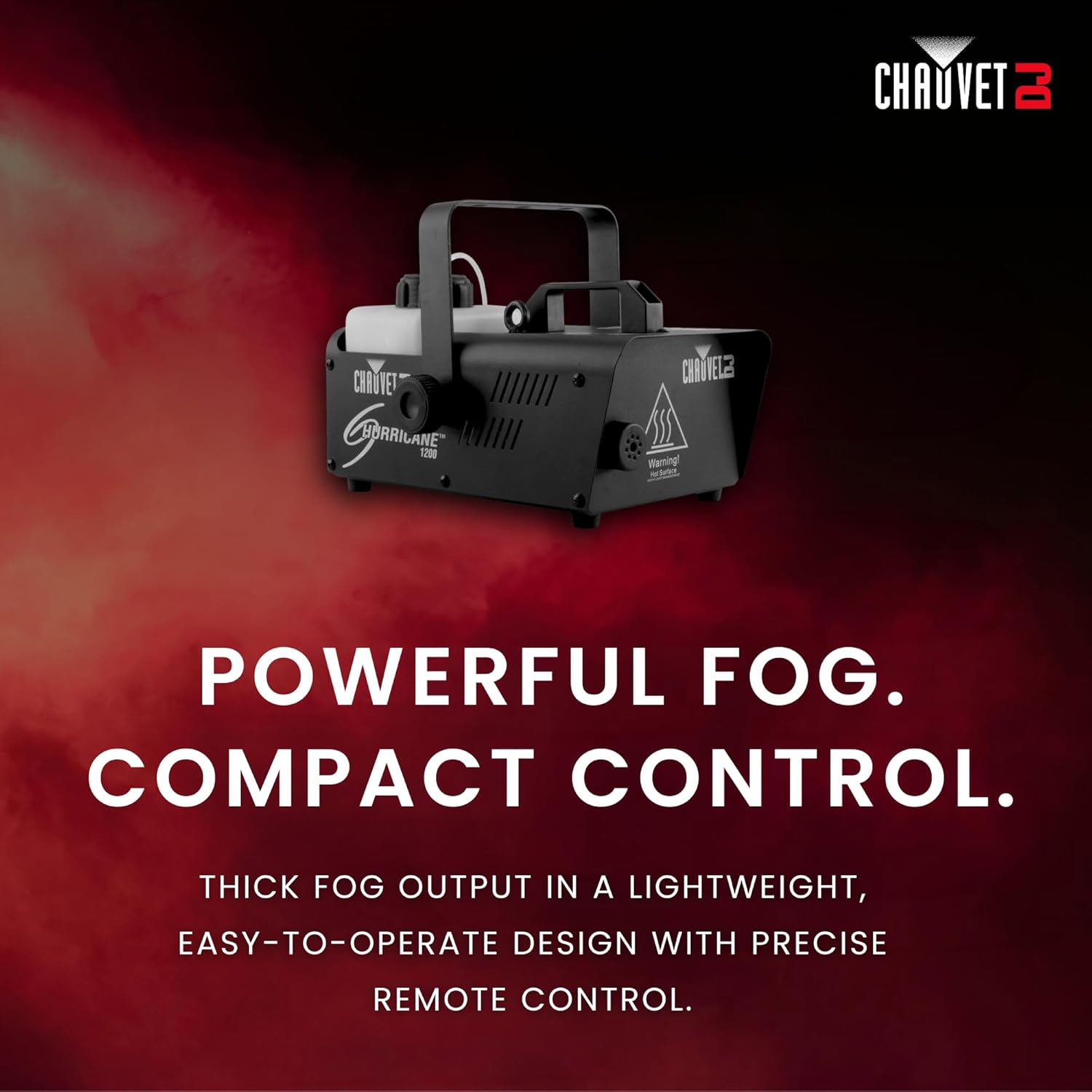
If you’ve ever watched a horror movie and seen thick, low-lying mist creep across the floor, you’ve seen a fog machine at work. A fog machine (also called a fogger or atmospheric effects generator) heats a water-based fluid — sometimes called fog juice — until it vaporizes into a cloud of tiny droplets that hang in the air and scatter light. The result is dramatic atmosphere: reduced visibility, eerie ambiance, or a canvas for laser effects and spotlights. For escape room operators and live event producers, a fog machine isn’t a party novelty — it’s a piece of working infrastructure that runs multiple hours a day, session after session, and needs to deliver consistent output every single time. This guide breaks down what separates a hobbyist fogger from a pro-grade machine, which specs actually matter for your context, and how to match the right unit to your venue size and budget.
Why “Pro-Grade” Is More Than a Marketing Label
Walk into any pro-audio or theatrical lighting supplier and you’ll notice that professional fog machines cost three to eight times more than the units at big-box party stores. Before you dismiss that gap as margin-padding, it’s worth understanding what the spec sheets and long-run operator reviews actually point to.
Duty cycle is the first differentiator. Consumer foggers are typically rated for intermittent use — a burst every few minutes to let the heating element recover. In an escape room running back-to-back sessions six days a week, that recovery model fails quickly. Professional units are rated for continuous or near-continuous output, meaning the heating block (called the heat exchanger) is engineered to sustain temperature without spiking, dropping, or burning fluid prematurely.
Output volume is measured in cubic feet per minute (CFM) — how much fog the machine can push into a space per minute. As a rough baseline: a 1,500-watt consumer unit might claim 5,000–7,000 CFM on the box, but operator reviews consistently flag that rated output drops significantly once the unit has been running more than 20 minutes. Pro units in the 1,500–3,000 watt range are rated to hold their stated CFM over the course of a full operational shift.
Fluid compatibility matters more than buyers expect. ESTA’s guidelines on atmospheric effects note that different fluid formulations — standard water-based fog, low-lying cryo-style glycol fluids, and water-based haze fluids — require different heat exchanger temperatures and pump pressures. Pro units typically publish a compatibility matrix and are calibrated for specific fluid grades. Running an incompatible fluid accelerates residue buildup and voids manufacturer warranties.
By the numbers — typical spec comparison:
| Class | Wattage | Rated CFM | Duty Cycle | Fluid Capacity | Typical Street Price (May 2026) |
|---|---|---|---|---|---|
| Consumer party | 400–700 W | 2,000–4,000 | Intermittent | 0.5–1 L | $25–$80 |
| Prosumer DJ/event | 1,000–1,500 W | 5,000–10,000 | 70–80% | 2–3 L | $120–$280 |
| Pro theatrical | 1,500–3,000 W | 10,000–25,000 | Continuous | 3–5 L | $350–$900+ |
Numbers sourced from manufacturer-published spec sheets and corroborated across distributor catalogs reviewed by PLSN’s annual buyer’s guide.
The Specs That Actually Move the Needle for Escape Rooms
Escape room operators and event producers have a different requirements profile than a wedding DJ. Here’s where the tradeoffs get real.
Warm-Up Time and Remote Triggering
A typical escape room session starts on a fixed schedule. If your fog machine takes four minutes to reach operating temperature, that’s four minutes your game master is stalling players at the door. Pro units in the $350–$600 range almost universally offer DMX control (DMX-512 is a standard lighting-control protocol used in professional entertainment environments — think of it as a single cable that lets a control board operate dozens of fixtures and effects simultaneously) and a dedicated remote timer. Operators in long-run reviews on professional event forums consistently cite warm-up time as the make-or-break daily friction point, not raw CFM output.
Fluid Tank Size and Refill Logistics
A 1-liter tank running at high output during consecutive 60-minute sessions will need a mid-shift refill. In high-throughput venues — four or more rooms, ten-plus sessions daily — that refill adds up to meaningful labor cost and interruption risk. Professional units with 3–5 liter tanks, or those with external reservoir fittings for larger jugs, reduce this friction substantially. Rosco Laboratories’ product documentation for their atmospheric fluid line notes that consumption rates vary by output setting and ambient temperature, but a 3-liter tank at moderate output typically sustains two to three full escape room sessions before requiring a refill.
Ventilation and Safety Compliance
This one gets under-weighted in pre-purchase research. OSHA’s fact sheet on theatrical smoke and fog makes clear that water-based fog fluids are generally low-hazard in properly ventilated spaces, but venues with poor air exchange can see fluid particulate accumulate at levels that trigger smoke detectors or irritate guests with respiratory sensitivities. Live Design magazine’s practitioner roundtable from their 2025 atmospheric effects feature quoted multiple production designers who emphasized that choosing the right fluid grade — rather than cranking up machine output — is often the smarter path to visible, lingering fog without detector false-alarms. The spec conversation isn’t just about the machine; it’s about the fluid-venue-machine triangle.
Three Picks Worth Serious Consideration
We haven’t run these units ourselves — our analysis is built on published specifications, distributor documentation, and the pattern across operator reviews from professional event communities. That said, when we compared the data, three machines stood out as the clearest value propositions for different buyer profiles.
For Mid-Volume Escape Rooms: The 1,500 W DMX Continuous-Duty Tier
Units in this class — from manufacturers like Antari (the Antari F-80Z is a frequently cited example in PLSN’s buyer guides), ADJ, and Chauvet Professional — publish continuous-duty ratings, include DMX-512 and wired remote options, and typically carry 2–3 liter tanks. Street prices in May 2026 sit in the $280–$450 range depending on dealer. Operators running two to four rooms consistently report that one unit per room at this tier handles back-to-back sessions without thermal recovery issues that plagued their previous prosumer units. The tradeoff: these units are not typically rated for outdoor use without additional weather shielding, and their fluid consumption at high output can exceed budget-tier fluid costs quickly — Rosco and Martin (now part of Harman) fluids optimized for these heat exchangers run $30–$60 per gallon versus $12–$18 for generic alternatives.
For High-Throughput Commercial Venues: The 2,000–3,000 W Theatrical Tier
If you’re running six-plus rooms, a large haunted attraction, or a live event requiring consistent atmospheric coverage over a 200+ square foot space for several hours, the conversation shifts to units like the Look Solutions Unique 2.1 or the Antari HZ-500 hazer (a hazer produces a finer, more even atmospheric haze rather than dense rolling fog — better for laser-effect visibility, less dramatic for floor-level mist). These units are rated for true continuous output, carry external fluid connections, and include professional DMX profiles compatible with most lighting consoles. ESTA’s published guidelines specifically reference units in this class as appropriate for enclosed venue theatrical use. Street prices range $600–$1,200 at authorized dealers. The tradeoff is straightforward: higher upfront cost, higher fluid throughput, and the need for a staff member who understands basic DMX patching. For venues doing this at scale, the per-session cost math favors the investment within three to six months of operation.
For Live Events and One-Off Productions: The Rental-or-Own Decision Point
Event producers who run intermittent productions — ten to twenty events per year rather than daily operations — face a different calculus. Operators in professional event forums and in Live Design’s roundtable coverage consistently note that purchasing a $500–$900 theatrical fogger only makes sense above roughly fifteen to twenty owned-event days per year, factoring in storage, fluid inventory, and maintenance. Below that threshold, renting from a theatrical supplier at $75–$150 per day (with fluid included) often wins on total cost. The exception: event producers who also own a permanent venue or run escape rooms on non-event days — in that case, the dual-use case almost always justifies ownership.
Fluid, Maintenance, and the Real Cost of Ownership
The purchase price is the most visible number, but it’s not the dominant cost over a two-year operational horizon. Here’s the math that experienced operators cite most frequently:
Fluid cost at serious operating volumes runs $800–$2,000 annually for a typical multi-room escape room facility using professional-grade fluid. Generic fluid is cheaper upfront but generates more residue buildup in the heat exchanger, which accelerates the maintenance cycle and can shorten unit lifespan. Rosco’s fluid data sheets document the chemistry differences between their formulations and generic alternatives, and most professional unit manufacturers explicitly tie warranty coverage to approved fluid use.
Heat exchanger cleaning is the maintenance task that separates operators who get five-plus years from their units from those who replace machinery every eighteen months. Professional units designed for easy disassembly of the heat exchanger block make this a 20-minute quarterly task. Units where the exchanger is sealed or difficult to access accumulate residue over time, leading to inconsistent output and eventually element failure.
Spare parts availability — particularly heating elements and pump assemblies — should factor into brand selection. Antari, Chauvet, and ADJ maintain North American parts distribution. Some lower-cost theatrical alternatives from European or Asian manufacturers have longer parts lead times that can mean days of downtime for a working escape room.
The Decision Rule
If you’re in the planning phase for a new build or re-equipping an existing venue, here’s the framework we’d use:
- If you’re running fewer than four sessions daily in a single room with a budget under $350: A high-quality prosumer unit (1,000–1,500 W, DMX-capable, reputable brand) handles the load. Don’t overspend.
- If you’re running four-plus rooms or high-throughput back-to-back sessions: The 1,500–2,000 W continuous-duty tier earns its price within months. Budget for professional fluid.
- If you’re a live event producer running fewer than fifteen owned-event days per year: Rent. Invest the capital elsewhere.
- If you’re building a permanent commercial attraction or science center installation: Go theatrical tier, spec for external fluid reservoirs, and build a basic DMX control workflow into your operations training.
The fog machine is rarely the most glamorous line item in an escape room or event budget, but it’s one of the first things guests notice — and one of the first things they mention in reviews when it’s working poorly. Matching the unit to the operational reality, not just the square footage, is where experienced operators consistently outperform first-time buyers.