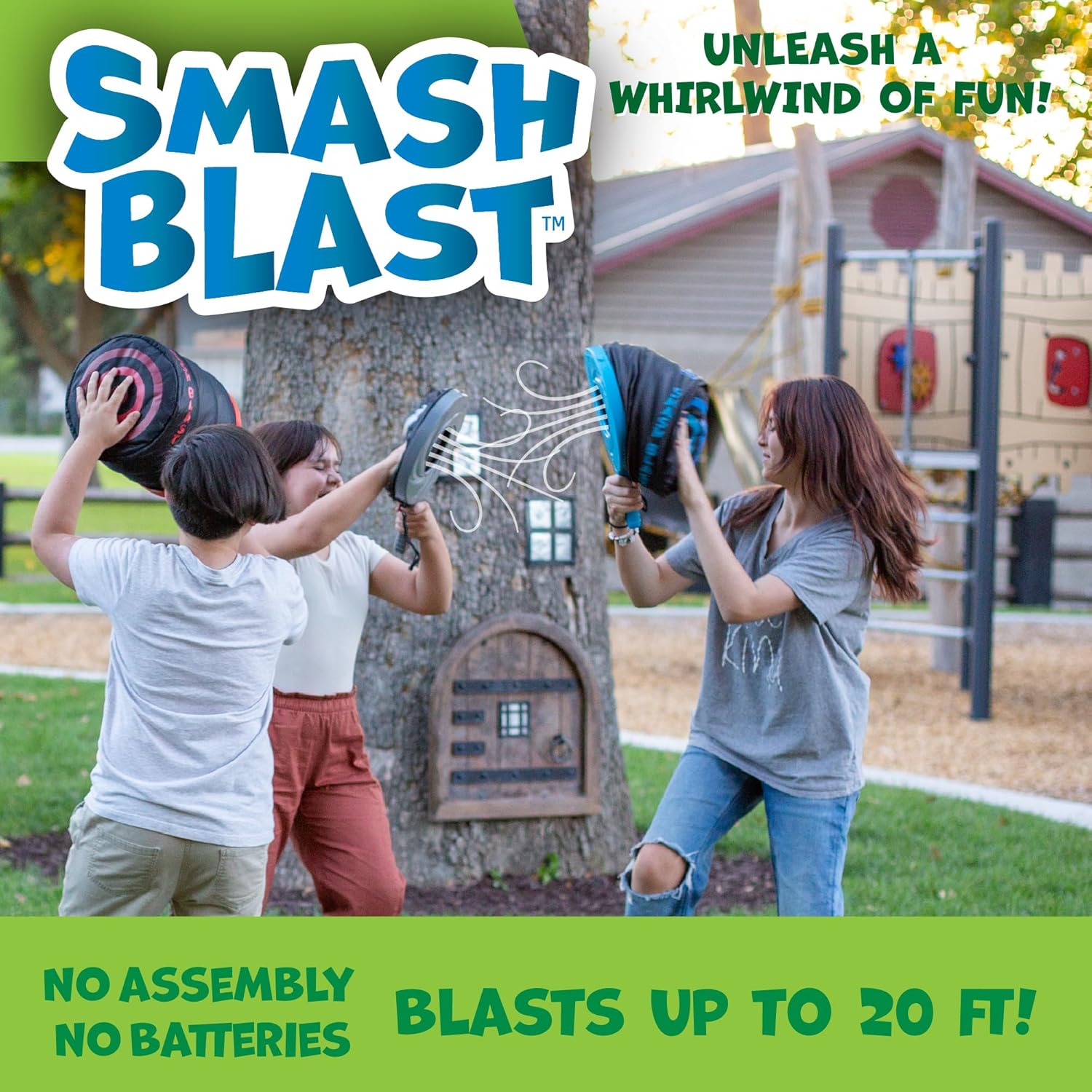
If you’ve ever watched a smoke ring drift slowly across a quiet room, you’ve already seen the physics at the heart of this whole category. A vortex ring is a spinning doughnut of air that holds its shape surprisingly well as it travels — the outer edge spins back toward the center, which keeps the ring tight and coherent rather than dispersing like a regular puff of air. An air vortex launcher is simply a device that creates bigger, faster, more forceful versions of those rings — usually by snapping a stretched membrane or flexible cone to push a concentrated burst of air out through a circular opening. Point one at a paper cup ten feet away and the cup goes flying. That’s the whole trick, and it never gets old.
What does get complicated — and what this article is here to sort out — is which launchers generate enough knockdown force to work reliably as target-shooting setups, which ones are genuinely rapid-fire capable, and how the math of vortex energy translates into practical target performance. We’ve read through every published spec sheet, aggregated owner review thread, and educator field note we could find so you don’t have to. If you’re here with a purchase decision already in motion, here’s what you need to know.
Why “Knockdown Force” Is the Variable That Actually Matters
Most vortex launcher marketing leads with range — “knocks targets down from 15 feet!” — because range is easy to visualize and photograph. But range and knockdown force are related, not identical, and confusing them is the most common mistake buyers make when setting up a target-shooting activity.
Here’s the underlying physics, as Scientific American’s explainer on vortex ring formation describes it: a vortex ring loses coherence gradually as it travels, and the energy available to knock something over is highest close to the launcher’s aperture and drops off nonlinearly with distance. That means a launcher rated for “15-foot range” may produce a satisfying ring you can see at 15 feet but deliver knockdown force only reliably within 6–8 feet, depending on the aperture diameter and membrane tension.
The variables that actually determine target-toppling performance:
- Aperture diameter (the size of the hole the air exits through): larger apertures produce larger-diameter rings that carry more total air mass, which means more push on impact. This is why commercial vortex cannons — with 6-to-12-inch apertures — are categorically different from consumer handheld units with 2-to-3-inch openings.
- Membrane tension and displacement (how far the firing membrane is pulled back and how quickly it snaps): this determines exit velocity. Higher tension = faster ring = less time for the ring to dissipate = more force at a given distance.
- Target characteristics: a tall, narrow target (think: stacked cups) topples far more easily than a wide, low one. Most well-designed target sets account for this.
Steve Spangler Science’s vortex cannon activity guide makes this point explicitly for classroom setups: the guide recommends positioning lightweight targets — empty plastic cups, foam cylinders, lightweight cardboard figures — no more than 8 feet from the launcher for reliable knockdown in repeated-fire drills.
The Launcher Tiers and What Each Can Realistically Do
Entry-Tier Handheld Units ($15–$30): Fun, Limited Repeatability
The Spin Master AirZooka is the category reference point here. Its aperture runs approximately 4 inches in diameter, the latex membrane has a moderate pull distance, and the unit is genuinely satisfying to use. Reviewers at The Spruce consistently note it as a strong impulse-gift pick precisely because the ring is visible, travels well across a room, and produces enough force to knock over lightweight targets — empty cups, small foam blocks — at 4–6 feet.
What it can’t do reliably: rapid fire. The latex membrane takes 1–2 seconds to fully recover between shots, and if you fire again before it seats properly, the ring is noticeably weaker. For target-shooting activities involving timed rounds, this matters. Owners in aggregated review threads frequently describe the AirZooka as best for casual, turn-based target play rather than fast-paced sequential shooting.
The Zero Blaster (technically a fog vortex unit, so it adds a fog-ring visual) sits in a similar range tier and shares similar force characteristics. Its primary value-add is the visual feedback — you can see the ring in flight — which Educational Innovations’ product notes highlight as particularly useful for classroom physics demonstrations. For pure knockdown performance at speed, it doesn’t outclass the AirZooka.
Decision frame: If you’re buying for casual backyard play or a single-shooter game where turns are the structure, this tier works. If rapid-fire repeatability or consistent force beyond 6 feet is the requirement, move up.
Mid-Tier Kits and Prosumer Units ($40–$120): Where Target Shooting Gets Serious
This is the tier where target-shooting setups start to function the way buyers envision them. The key differentiators at this level are larger apertures (typically 5–7 inches), stiffer membrane materials with faster recoil, and in some cases interchangeable tension settings.
The Vortex Blaster kits that Educational Innovations stocks for classroom programs are built specifically for repeated demonstration use — their product documentation notes that the units are designed to fire multiple times per minute without membrane fatigue, which is the spec that matters for target-shooting activities with a rotating group of students or event guests.
Owners of mid-tier units across aggregated review discussions consistently report two things: (1) knockdown performance at 8–12 feet is noticeably more reliable than entry-tier units, and (2) the units benefit significantly from target design — specially designed lightweight target sets (stackable foam cylinders, self-righting disc towers) produce a better experience than improvised cup setups at this range.
By the numbers:
| Tier | Typical Aperture | Reliable Knockdown Range | Membrane Recovery | Approximate Price |
|---|---|---|---|---|
| Entry handheld | 3–4 in | 4–6 ft | 1.5–2 sec | $15–$30 |
| Mid-tier kit | 5–7 in | 8–12 ft | 0.8–1.2 sec | $40–$120 |
| Commercial/pro | 8–14 in | 15–25 ft | 0.5 sec or less | $150–$500+ |
Ranges compiled from published manufacturer specs and aggregated owner reports; your results will vary with target weight and environmental conditions.
Commercial and Pro-Grade Units ($150–$500+): Built for Throughput
At this tier, we’re talking about air cannons built for event environments, escape rooms, and science center activations where the launcher fires dozens or hundreds of times per session without degradation. The design philosophy shifts completely: membranes are often replaced with mechanical actuation systems (a bellows or pneumatic release), apertures run 8–14 inches, and some units allow adjustable force settings for different target configurations.
Popular Mechanics’ coverage of large-format vortex cannon demonstrations notes that properly tuned commercial units can produce rings that remain coherent and force-capable at 20–25 feet — a genuinely different category of performance. Escape-room designers and event producers who’ve documented their setups in maker community write-ups describe the ability to knock over targets ranging from foam blocks to lightweight cardboard standees with high consistency across many sequential firings.
The tradeoff is obvious: these units are large, require more storage space, and in some pneumatic configurations need an external air source. For a science center with permanent installation space, that’s a non-issue. For a birthday party host who wants to set something up in a living room and pack it away afterward, it’s a dealbreaker.
Target Design: The Half of the Equation Most Buyers Underestimate
Here’s the thing we consistently see in owner reviews and forum discussions that doesn’t get enough attention in product marketing: the launcher accounts for maybe 60% of target-shooting performance. The other 40% is the target.
The Physics Classroom’s resource on momentum and impulse (which applies directly to why vortex rings knock things over) makes the underlying principle clear: knockdown depends on the force applied relative to the target’s mass and its center of gravity height. A tall target with a high center of mass tips more easily than a low, heavy one at the same impulse.
Practical implications for setting up a target-shooting activity:
- Stack lightweight items vertically — the taller the stack, the easier it tips. Empty plastic cups stacked 3–4 high are a staple for good reason.
- Use self-righting or weighted-base targets only if you want a challenge mode — these require significantly more force and are better matched to commercial-tier launchers.
- Distance is a dial you can tune — if your mid-tier unit is struggling at 10 feet, moving the target to 7 feet isn’t cheating, it’s calibration.
- Surface matters — targets on smooth hard floors tip more easily than on carpet, because carpet creates base friction that requires the vortex to tip rather than slide the target.
The Decision Rules
We’ve read enough owner accounts and spec documentation at this point to be confident in the following if/then framework:
If you want casual, single-shooter target play for home or small group use, budget under $30: The Spin Master AirZooka is the honest answer. It works, it’s proven, and owners reliably report satisfaction for the use case. Set targets at 4–6 feet, use lightweight cups, manage expectations on rapid fire.
If you’re running a structured activity — classroom, birthday party game, event station — with multiple users rotating through and targets set at 8–12 feet: Invest in a mid-tier kit in the $40–$120 range with documented membrane durability. Pair it with a dedicated lightweight target set rather than improvised cups. Educational Innovations’ catalog is a solid starting point for classroom-proven options.
If you’re designing a permanent or semi-permanent installation — escape room, science center exhibit, recurring event — where throughput, reliability over hundreds of cycles, and consistent performance at distance are requirements: The commercial tier is the only honest answer. The math on replacement cost, participant experience, and brand impression all favor spending $150–$500+ upfront rather than cycling through entry-tier units every season.
If rapid-fire is the core mechanic of your activity (timed rounds, competitive multi-target formats): Membrane recovery time is the spec to prioritize above range. Mid-tier and commercial units with sub-second recovery are the only realistic options; entry-tier launchers will frustrate players and event staff equally.
The vortex category has enough genuine performance spread across its tiers that there’s a right answer for almost every use case — the trap is just buying on range spec alone and discovering the knockdown reality afterward. We’ve done the reading so you can skip that part.